
Cognitive Behavioral Therapy: Types, Benefits, and Applications

Psychiatrist
Senior Research Executive
Cognitive behavioral therapy is one of the most widely used forms of mental health therapy. That is why it continues to be recommended by mental health providers so often. It is practical, structured, and focused on the patterns that keep people stuck in the same loops.
Instead of circling endlessly around distress, CBT works on the connection between thoughts, emotions, and behavior. That connection matters because the way a person interprets an experience can intensify fear, deepen sadness, fuel avoidance, or keep negative thinking in motion.
At AZZ Medical Associates, cognitive-behavioral therapy is valued because it offers patients more than temporary reassurance. It teaches skills that can be used in daily life. For someone living with anxiety, depression, panic attacks, intrusive thoughts, trauma-related distress, or insomnia, that shift can be meaningful.
The goal is not to pretend problems do not exist. The goal is to help patients respond to them with greater clarity, steadier emotional regulation, and healthier coping skills.

What Is Cognitive Behavioral Therapy?

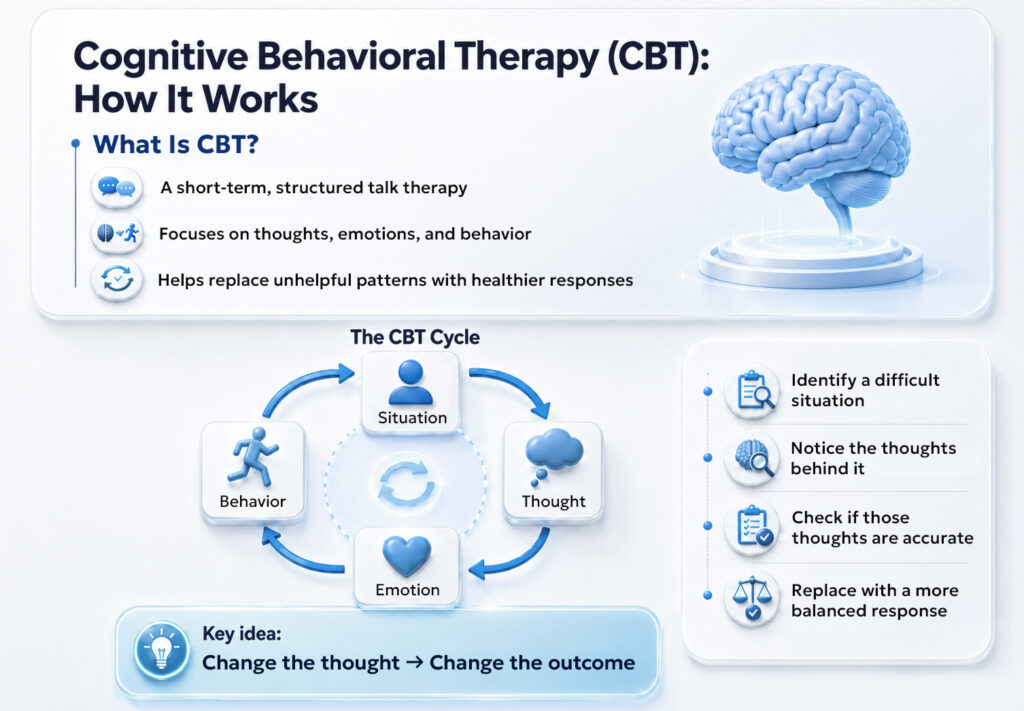
People often want to know what CBT therapy is. The clearest answer is this: it is a short-term, goal-oriented form of talk therapy that helps people identify unhelpful thought patterns and learned behavior patterns, then replace them with more balanced and useful responses. CBT is built on the idea that thoughts, feelings, and actions influence one another. When thinking becomes distorted, behavior often follows in ways that make symptoms worse.
A person with anxiety may assume the worst before anything has happened. A person with depression may treat one setback as proof that nothing will improve. Someone with OCD may misread intrusive thoughts as danger. Someone with social anxiety may interpret an ordinary interaction as rejection.
In each case, the mind moves quickly, often automatically, and the emotional reaction feels real because the thought behind it goes unchallenged. CBT helps slow that process down.
This is what makes cognitive behavioral therapy techniques so useful. They are not abstract ideas. They are tools designed to help people notice distorted self-talk, question it, and respond in a different way.

Need help with anxiety, depression, or overwhelming stress?

Explore cognitive behavioral therapy at AZZ Medical Associates and take the next step toward practical, evidence-based mental health support.

How CBT Works

In a nutshell, CBT is collaborative. The therapist brings structure, training, and therapeutic guidance. The patient brings lived experience, goals, and day-to-day patterns that need to be understood. Together, they identify the problem, examine the thought patterns connected to it, and begin practicing better ways to respond.
The process usually starts with a clear focus. Rather than exploring everything at once, CBT looks at the most important issues affecting daily life now. That may include worry, panic, low mood, avoidance, rumination, poor sleep, shame, hopelessness, or recurring conflict. From there, treatment often moves through a few key steps:
  • You identify a troubling situation.
  • You notice the thoughts and beliefs attached to it.
  • You examine whether those thoughts are accurate, distorted, or incomplete.
  • You practice a more grounded response.
  • You test that response in real life.
That is why people often describe CBT as active treatment. It is not just insight. It is practice. Between sessions, there may be journaling, reflection, self-monitoring, structured exercises, or small behavior changes meant to reinforce what was discussed in session. Those CBT homework assignments are part of how people build lasting change.

Looking for structured therapy that teaches real coping skills?

Connect with AZZ Medical Associates to learn whether cognitive behavioral therapy is the right fit for your care.

What CBT Helps Treat

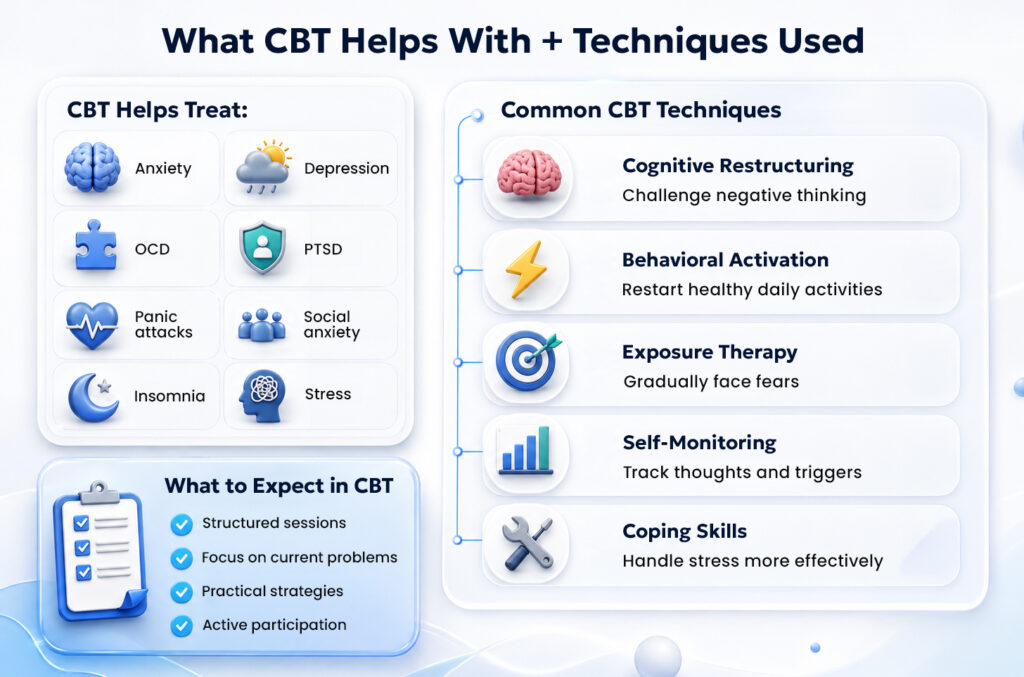
One reason CBT remains so important is its broad clinical use. It is commonly used for depression, anxiety, phobias, post-traumatic stress disorder, obsessive-compulsive disorder, panic disorder, stress-related problems, eating disorders, substance use concerns, insomnia, and some chronic pain conditions. In some cases, it is used alone. In others, it is paired with medication or a broader psychiatric treatment plan.
That makes CBT especially relevant for patients searching for:

Cognitive behavioral therapy for anxiety: CBT helps patients identify fear-based predictions, catastrophic thinking, and avoidance behaviors that keep anxiety active.
Cognitive behavioral therapy for depression: It addresses hopeless thought patterns, low motivation, withdrawal, and the cycle that can make depression harder to break.
Cognitive behavioral therapy for OCD: Treating OCD with cognitive behavioral therapy often involves learning how to respond differently to intrusive thoughts and resist compulsive patterns.
Cognitive behavioral trauma therapy: Trauma-focused CBT approaches can help people work through fear, distress, and the beliefs that often follow traumatic experiences.
Cognitive behavioral therapy for insomnia: CBT for sleep problems targets the thinking and habits that keep insomnia going, especially when stress and sleep anxiety feed each other.
CBT for social anxiety, panic disorder, agoraphobia, and intrusive thoughts: In each of these areas, the therapy focuses on challenging distorted predictions and reducing avoidance.

At AZZ Medical Associates, that practical range is part of what makes CBT valuable. It can be adapted to the patient in front of you rather than forced into a one-size-fits-all model.

Why CBT Often Helps When People Feel Stuck

One of the most useful things about CBT is that it gives patients a way to slow down automatic reactions.

Many people do not realize how quickly the mind can move from a stressful event to a painful conclusion. A delayed reply becomes a rejection.

One mistake becomes failure. A physical sensation becomes danger. Once that pattern repeats often enough, the emotional response starts to feel inevitable.
CBT works by helping patients catch that process earlier.

Instead of accepting every thought as fact, they learn to question it, test it, and replace it with something more accurate.

That shift does not erase stress, but it often reduces the intensity of anxiety, shame, hopelessness, and avoidance.

In practice, this is where real improvement begins: not when life becomes perfect, but when the person becomes less controlled by distorted thinking.

Common CBT Techniques

People often ask for CBT therapy techniques explained because they want to know what actually happens in treatment. While no two treatment plans are identical, several methods are often used.

Cognitive restructuring helps a person identify harmful interpretations and replace them with more realistic ones. This does not mean forced positivity. It means learning to tell the difference between a fact and a fear-driven conclusion.
Behavioral activation is often used in depression. When someone stops doing the things that once supported energy, structure, or enjoyment, their mood often drops further. Behavioral activation helps reintroduce healthy action before motivation fully returns.
Exposure therapy is used for many anxiety-related concerns, including phobias, panic, OCD, and trauma-related avoidance. The point is not to overwhelm the person. The point is to reduce fear by gradually facing what has been avoided in a careful, planned way.
Self-monitoring helps patients track situations, emotions, body sensations, and thought patterns. This can be especially useful for panic attacks, rumination, and negative thinking that feels automatic.
Problem-solving and coping skills help patients respond to stress more effectively instead of getting trapped in shutdown, anger, or helplessness.
These are the kinds of evidence-based therapy methods that make CBT different from vague advice. The work is specific, and the goal is usable change.

What to Expect in a CBT Session

A common question is what to expect in a CBT session. Most sessions are structured. You and the therapist usually review what has been happening, what symptoms or situations stood out, what thoughts were triggered, and what response patterns followed. Then the session moves into practical work: examining the problem, identifying distortions, practicing a new perspective, and deciding what to work on between sessions.
The therapist may ask you to notice patterns such as catastrophizing, all-or-nothing thinking, overgeneralization, personalization, or emotional reasoning. These are all examples of how the mind can make a hard situation feel even harder. Once those habits become easier to spot, they also become easier to interrupt.
Some sessions feel encouraging. Others can feel uncomfortable because they ask you to face what you usually avoid. That does not mean therapy is failing. In many cases, it means you are working on the right material.

How Long Does CBT Therapy Take?

If you are asking how long CBT therapy takes, the answer depends on the condition, the severity of symptoms, and how consistently the skills are practiced. CBT is usually considered a short-term therapy approach. Some people improve in a few months, while others need longer support. Weekly sessions are common, and many treatment plans fall in the range of about 5 to 20 sessions, though timelines vary.
What matters most is not rushing the process. CBT works best when people stay engaged, show up consistently, and use the skills between sessions. It is meant to help patients become more capable outside therapy, not permanently dependent on it.

Looking for therapy that gives you tools, not just talk?

CBT helps you challenge negative thinking, manage emotional triggers, & regulate responses. Start your path forward with AZZ Medical Associates and learn whether cognitive behavioral therapy is right for you.

CBT vs Other Therapy Approaches

Comparing CBT vs DBT: which is better? The better question is which approach fits the problem.
CBT focuses heavily on thoughts, beliefs, learned behaviors, and current problems. It is structured and practical. DBT includes some of that, but it places stronger emphasis on distress tolerance, emotion regulation, mindfulness, and interpersonal effectiveness. One is not automatically better than the other. The right fit depends on the symptoms, diagnosis, and treatment goals.
The same is true when comparing behavior therapy and cognitive behavior therapy. Behavior therapy focuses more directly on learned behaviors and how they change. CBT includes behavior change, but it also addresses the thought patterns and beliefs underneath the behavior.
Online CBT therapy can also be effective for some patients. That can matter for people who have travel limitations, time constraints, or difficulty accessing care in person. The key issue is still quality: the treatment should be appropriate, structured, and guided by a qualified mental health professional.

Expert Insights

What Makes CBT More Effective

  • CBT tends to work best for patients who treat it like active care, not passive conversation.
  • The people who usually get the strongest results are the ones who practice outside the session. They track patterns.
  • They test new responses. They keep going even when progress feels gradual.
  • In real life, improvement often comes from repetition, not a single breakthrough.
  • A patient starts catching distorted thoughts earlier. Avoidance decreases. Sleep becomes less driven by fear. Panic feels less mysterious.
  • Mood becomes less controlled by automatic self-criticism. Those changes can look small at first, but over time they often become the foundation of durable progress.

Final Thoughts

Cognitive-behavioral therapy remains one of the most trusted treatment options in behavioral health because it offers people something they can actually use. It helps challenge cognitive distortions, reduce unhealthy behavioral patterns, improve emotional regulation, and build coping strategies that support daily life. For patients dealing with anxiety, depression, trauma-related symptoms, intrusive thoughts, or insomnia, CBT offers a practical path toward better functioning and better self-understanding.

Ready to break the cycle of anxiety, depression, or avoidance?

With the right support, it is possible to change the patterns that keep symptoms going. Reach out to AZZ Medical Associates for practical, personalized CBT support.

Search

Categories

Book an Appointment

Your healthcare starts with the right doctor. If your health raises a question, we’re here to help.
Table of Contents

Related Posts

Leaving so soon? Fill out the form and stay in touch!

Let's have a chat