Skip to content


ADHD is a neurodevelopmental condition that affects attention, impulse control, and activity level. It shows up differently depending on age, and it does not look the same in every person who has it.
A child with ADHD rarely has one clean symptom. Trouble finishing homework may involve difficulty sitting still, forgetting instructions partway through, and getting distracted by something across the room, all at once. Treating one piece, like the fidgeting, without looking at the whole pattern rarely solves the problem.
Age does not determine whether ADHD is present. What matters is whether attention, impulsivity, or activity level are consistently out of step with what is expected for that person’s age, and whether it is genuinely getting in the way of school, work, or relationships.
What Is ADHD?
ADHD, or attention-deficit/hyperactivity disorder, is a neurodevelopmental condition marked by patterns of inattention, hyperactivity, or impulsivity that are stronger and more frequent than typical for a person’s age.
ADHD is not a character flaw and not the result of poor parenting. It reflects real differences in brain structure and function, and it has a strong genetic component.
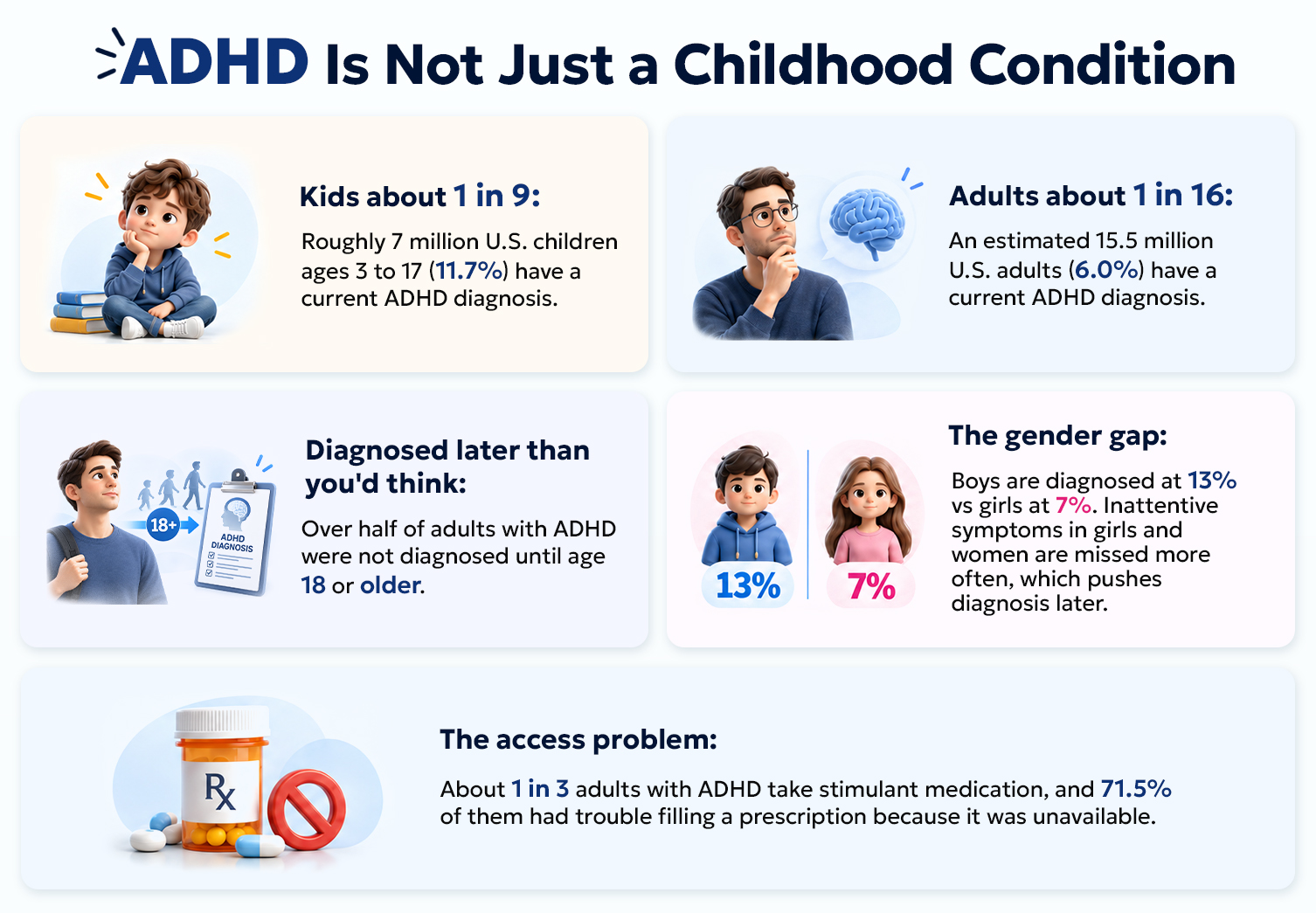
Symptoms usually begin in childhood, often between ages 3 and 6, and continue into adulthood in more than three-quarters of cases. For some people, ADHD is never recognized until adulthood, even though the pattern was present all along.
The Three Presentations of ADHD
ADHD is grouped into three presentations depending on which symptoms are strongest:
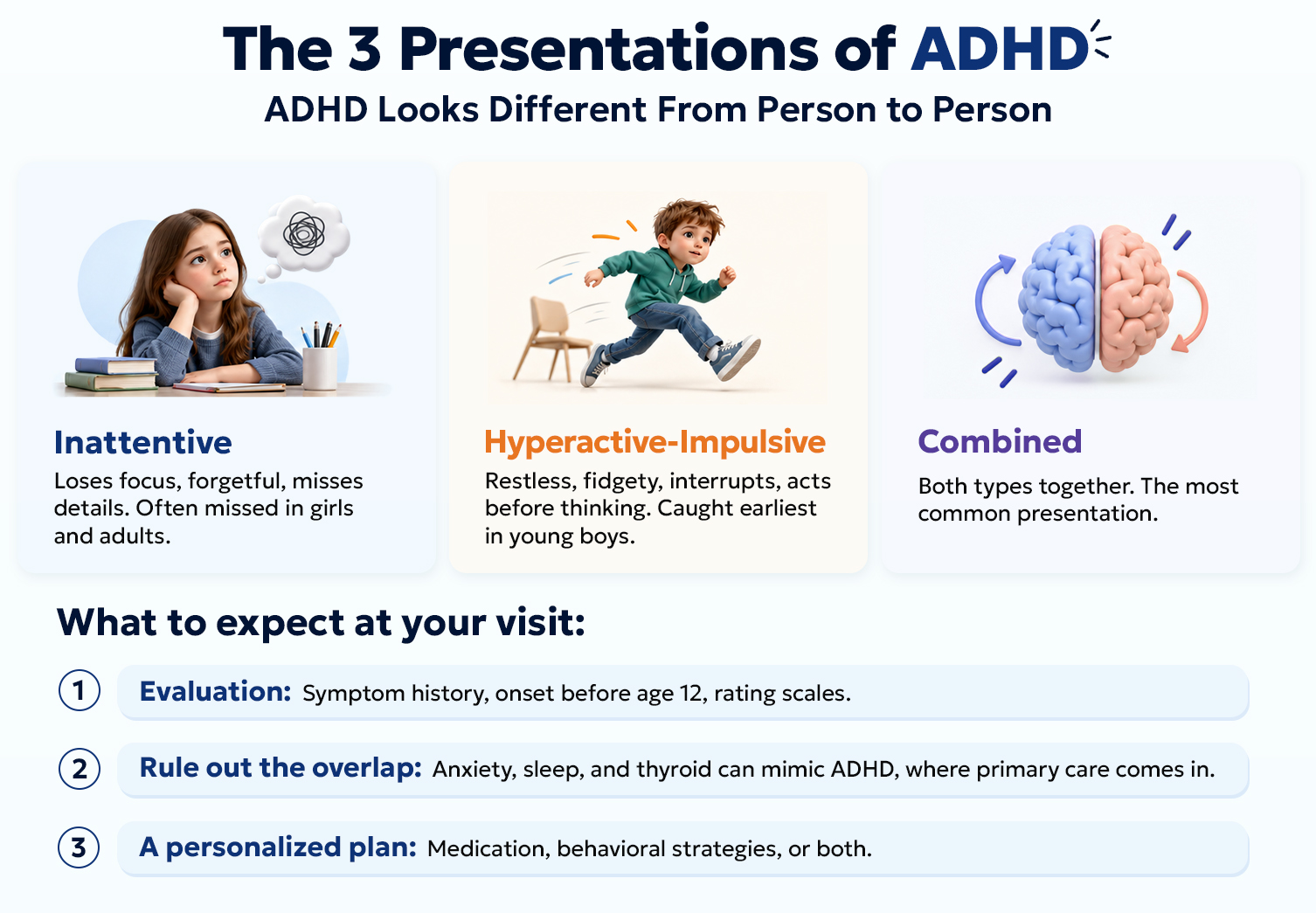
- Predominantly inattentive: Distractibility, forgetfulness, and difficulty sustaining focus, without significant hyperactivity. More common in girls and women, and more often missed for that reason.
- Predominantly hyperactive-impulsive: Restlessness, fidgeting, excessive talking, and acting before thinking, with fewer inattentive symptoms.
- Combined: Both inattentive and hyperactive-impulsive symptoms are present. This is the most common presentation.
A person’s presentation can shift over time. Hyperactivity in particular tends to soften with age, even when inattention and impulsivity remain.
How ADHD Affects Daily Life and Family Life
ADHD rarely stays contained to one area of life.
- School and work: Missed instructions, incomplete assignments, disorganization, and inconsistent performance despite genuine effort.
- Family life: Frustration, repeated reminders, and strain between a child and parents, or between partners when one adult has undiagnosed ADHD.
- Emotional health: Low self-esteem, sensitivity to criticism, and frustration that builds after years of being told to “try harder.”
- Daily functioning: Lost items, missed appointments, late bills, and a home or work life that feels harder to manage than it should.
- Relationships: Impulsive comments, interrupting, or forgetfulness that partners and friends can misread as not caring.
Expert Insights
ADHD affects roughly 1 in 10 children ages 3 to 17 in the United States, according to the CDC. Symptoms persist into adulthood in more than three-quarters of cases.
Who May Be Affected by ADHD
There is no single group ADHD affects. It appears across ages, genders, and backgrounds, though recognition has historically been uneven.
- Boys are diagnosed more often than girls, largely because hyperactive symptoms are more visible.
- Girls more frequently show the inattentive presentation, which is quieter and easier to overlook.
- A family history of ADHD raises the likelihood significantly, since genetics is the strongest known contributor.
- Adults who were never evaluated as children may only recognize the pattern once adult responsibilities expose it.
Whether ADHD needs evaluation is better judged by functional impact than by age or how “typical” someone’s symptoms look on the surface.
Signs It May Be Time for an ADHD Evaluation
Attention and Focus Signs
- Trouble sustaining attention during tasks or conversations
- Frequently losing items needed for school or work
- Difficulty following multi-step instructions
- Appearing not to listen even when spoken to directly
- Careless mistakes on schoolwork or job tasks
Hyperactivity and Impulsivity Signs
- Fidgeting, squirming, or difficulty staying seated
- Talking excessively or interrupting others
- Difficulty waiting for a turn
- Acting without considering the consequences
- A sense of internal restlessness, more common in adults than visible movement
Functional and Emotional Signs
- Chronic disorganization at home, school, or work
- Procrastination on tasks requiring sustained effort
- Rejection sensitivity or low frustration tolerance
- Missed deadlines, bills, or appointments
- A pattern of underperforming relative to actual ability
These signs do not confirm ADHD on their own. A healthcare provider can assess whether ADHD, another condition, or a combination of factors is contributing.
Concerned About Attention or Behavior Changes?
Trouble focusing, impulsivity, or disorganization affecting school, work, or daily life is worth discussing with a healthcare provider
What Causes ADHD
Genetic Factors
- ADHD has a strong hereditary component, with heritability estimated between 77% and 88%.
- A child with a parent who had ADHD is significantly more likely to have it as well.
- Researchers believe multiple genes, each contributing a small effect, combine to create risk.
Brain-Related Factors
- Differences in brain structure and function have been observed in people with ADHD, particularly in areas involved in attention and impulse control.
- These differences are believed to affect dopamine activity, which plays a role in focus and motivation.
Environmental Factors
- Lead exposure has been studied as a possible contributor to ADHD symptoms.
- Premature birth, low birth weight, and prenatal exposure to alcohol or tobacco have also been researched as risk factors.
- Environmental factors appear to interact with genetic risk rather than cause ADHD independently.
What does not cause ADHD
Conditions Often Seen Alongside ADHD
ADHD frequently occurs together with other conditions, which can complicate both diagnosis and treatment.
- Anxiety: Can produce distractibility that overlaps with inattentive ADHD symptoms.
- Depression: May share symptoms like poor concentration and low motivation.
- Learning disabilities: Can affect academic performance in ways that resemble or accompany ADHD.
- Sleep problems: Poor sleep can mimic or worsen inattention and irritability.
- Substance use: Untreated ADHD in adolescents and adults carries increased risk for substance misuse.
Identifying whether one, several, or none of these conditions are present alongside ADHD is part of a thorough evaluation.
What Does an ADHD Evaluation Include?
For Children
- A checklist rating ADHD symptoms, typically completed by parents and teachers
- Confirmation that symptoms were present before age 12
- Review of behavior across more than one setting, such as home and school
- A medical and psychological exam to rule out other explanations
For Adults
- A detailed interview covering current symptoms and childhood history
- Standardized adult rating scales assessing symptoms over recent months
- Input from family members or close contacts when available
- Assessment of how symptoms affect work, relationships, and daily functioning
- Evaluation to rule out anxiety, depression, sleep disorders, or other conditions with overlapping symptoms
Bringing report cards, prior evaluations, or notes from someone who knew you as a child can make an adult evaluation more accurate.
Screening Tools and Frameworks
Providers may use several structured tools depending on the patient’s age and presentation.
- DSM-5 criteria: The diagnostic framework requiring a specific number of symptoms, present before age 12, causing impairment in more than one setting.
- ASRS (Adult ADHD Self-Report Scale): A screening tool used to evaluate adult symptoms.
- Vanderbilt and Conners rating scales: Standardized questionnaires completed by parents and teachers for childhood ADHD.
- Structured clinical interview: A conversation covering history, functioning, and symptom patterns that ties the screening results together.
A screening tool result alone does not confirm ADHD. It supports, but does not replace, a full clinical evaluation.
Not Sure If It's ADHD?
An evaluation can clarify what is actually happening, whether that is ADHD, another condition, or several factors together.
How Treatment Helps Manage ADHD
Medication Management
- Stimulant medications, including methylphenidate and amphetamine-based options, are the most studied and commonly used first-line treatment.
- Non-stimulant medications are available for patients who do not tolerate stimulants well.
- Roughly 70% of children with ADHD see meaningful improvement with stimulant treatment.
- Medication is monitored and adjusted over time based on response and side effects.
Behavioral Therapy
- Especially important for younger children, focusing on structure, consistency, and reinforcement.
- Helps translate intentions into follow-through through concrete routines.
Skills Training and Counseling
- More relevant for adults, covering organization, time management, and coping strategies.
- Counseling addresses the emotional impact of ADHD, including low self-esteem and rejection sensitivity built up over years.
Combined Approach
ADHD vs. Normal Childhood Behavior
Every child is inattentive, restless, or impulsive sometimes. The distinction with ADHD is persistence and impact.
- Typical behavior is occasional and does not significantly disrupt school, friendships, or home life.
- ADHD-related behavior is consistent across settings, does not resolve with typical redirection, and causes real difficulty over time.
- Children with ADHD do not simply grow out of these patterns the way they outgrow a phase.
If a pattern has lasted for months, shows up in more than one setting, and is affecting a child’s functioning, it is reasonable to raise it with a provider rather than assuming it will pass.
When Should Someone Be Evaluated for ADHD?
Consider an evaluation when there is a persistent pattern of:
- Inattention or distractibility affecting school or work performance
- Impulsivity causing problems in relationships or decision-making
- Hyperactivity or restlessness that disrupts daily functioning
- Disorganization that has not improved with typical strategies
- A teacher, employer, or family member repeatedly raising concerns
- A new, unexplained decline in performance or follow-through
When to Seek Urgent Support
ADHD itself is not a medical emergency, but co-occurring conditions can create situations that need prompt attention.
Seek urgent evaluation if impulsivity leads to situations involving safety, or if symptoms of depression, including thoughts of self-harm, are present alongside ADHD. If you or someone you know is in crisis, call or text 988 to reach the Suicide and Crisis Lifeline, or call 911.
ADHD Care for Children and Adults in New Jersey
For families and adults in New Jersey, primary care is often the right starting point for an ADHD concern.
A primary care provider can review current symptoms, developmental or personal history, school or work performance, and any co-occurring concerns, then determine whether evaluation, treatment, or referral is the right next step.
Parent and Caregiver Participation
With the patient’s permission, parents and caregivers can take part in appointments and evaluations.
Their observations often provide context a single visit cannot, including:
- Behavior patterns at home versus school or work
- Changes noticed over time
- Response to previous strategies or treatments
- Family history relevant to the evaluation
For adult patients, a spouse or close family member may add useful perspective, though the adult remains central to their own care decisions.
Telehealth for ADHD Care
AZZ Medical Associates offers telehealth services in New Jersey for appropriate ADHD-related visits.
Telehealth may be useful for:
- Follow-up appointments
- Medication management check-ins
- Discussing symptoms and treatment response
- Behavioral health visits
Some situations still require an in-person visit, including certain initial evaluations and any concern needing physical examination. Your provider can help determine which format fits your situation.
ADHD Care at AZZ Medical Associates
AZZ Medical Associates provides ADHD evaluation and treatment for children and adults across New Jersey.
Services relevant to ADHD care include:
- Primary Care
- Pediatric Care
- Behavioral Health Services
- Medication Management
- Preventive Care
- Telehealth
Service availability and provider scheduling may vary by location. Patients should confirm availability with their preferred AZZ Medical Associates clinic.
Looking for ADHD Support in New Jersey?
AZZ Medical Associates provides evaluation, medication management, and behavioral support for ADHD across New Jersey.
How to Prepare for an Appointment
A little preparation makes an ADHD evaluation more accurate and efficient.
Consider bringing:
- A written list of specific symptoms and when they started
- Report cards, performance reviews, or prior evaluations if available
- Notes from a teacher, employer, or family member if relevant
- A current medication list, including supplements
- Family history of ADHD or related conditions
- Insurance information
It also helps to write down specific examples rather than general impressions, since concrete details make the evaluation more precise.
Lifestyle & Supportive Approaches
Medical treatment is central to managing ADHD, but daily habits support it.
- Consistent sleep schedules
- Regular physical activity
- Nutritious, regular meals
- Structured routines and visual reminders
- Breaking tasks into smaller steps
- Reducing environmental distractions during focused work
These approaches do not replace medication or therapy but can meaningfully support the effect of both.
Takeaway
ADHD is not a flaw in character or effort. It is a neurodevelopmental condition with a strong genetic basis, and it responds well to treatment once properly identified.
The pattern looks different at every age, quieter in some people, more visible in others, but the underlying difficulty with attention, impulse control, or activity level is consistent.
Identifying ADHD early, and treating it consistently, can meaningfully change how school, work, and relationships feel for both children and adults.
What is ADHD?
ADHD is a neurodevelopmental condition involving persistent patterns of inattention, hyperactivity, or impulsivity that are stronger than typical for a person's age and interfere with daily functioning.
Is ADHD genetic?
Yes. Genetics is the strongest known contributor, with heritability estimated between 77% and 88%. Family history raises the likelihood of ADHD significantly.
Can ADHD be cured?
No. ADHD is a lifelong condition, but it is highly treatable. Symptoms often become milder with age, and effective treatment can bring them under real, lasting control.
Can adults be diagnosed with ADHD for the first time?
Yes. Many adults had undiagnosed symptoms as children, particularly if their presentation was inattentive rather than hyperactive. Diagnosis still requires evidence symptoms were present before age 12.
Does ADHD look different in boys and girls?
Often, yes. Boys are diagnosed more frequently, partly because hyperactive symptoms are more visible. Girls more often show the inattentive presentation, which is quieter and more easily missed.
Will a child outgrow ADHD?
Not typically. Hyperactivity tends to decrease with age, but inattentive and impulsive symptoms frequently persist into adulthood
What conditions are commonly confused with ADHD?
Anxiety, depression, sleep disorders, and certain learning disabilities can produce overlapping symptoms, which is why a full evaluation is important before assuming ADHD is the cause.
Does insurance cover ADHD evaluation and treatment?
Coverage varies by plan. AZZ Medical Associates accepts major insurance providers, and staff can help verify your specific benefits before your appointment.
Can ADHD be managed without medication?
For some patients, especially with mild symptoms, behavioral strategies and skills training alone may be sufficient. For many others, a combination of medication and behavioral support produces the best results. This decision is made individually with your provider.