
Dialectical Behavior Therapy for Emotional Balance

Medically Reviewed by:
Dialectical behavior therapy, often shortened to DBT, is a structured form of psychotherapy designed for people who feel emotions very intensely and struggle to manage them in safe, steady ways. It grew out of cognitive behavioral therapy, but it adds something many patients need just as much as change: acceptance.
DBT teaches that both can be true at once. You can accept where you are right now and still work toward changing the behaviors that are harming your life.
That balance is what makes DBT different. Instead of telling patients to simply “think differently,” it helps them slow emotional reactions, tolerate distress without worsening it, respond more effectively in relationships, and build stronger emotional regulation over time.
At AZZ Medical Associates, this makes DBT a valuable option for patients whose symptoms are tied to emotional dysregulation, impulsive behavior, repeated crises, or unstable coping patterns.

What Is Dialectical Behavior Therapy?

Dialectical Behavior Therapy is a skills-based therapy that helps people manage intense emotions, improve relationships, and reduce behaviors that create harm or chaos. The word “dialectical” refers to bringing together ideas that seem opposite, especially acceptance and change. That is one of the central principles of DBT.
Psychologist Marsha Linehan originally developed DBT for people with borderline personality disorder and chronic suicidal or self-harming behavior. Over time, it has also been used for depression, anxiety, PTSD, substance use disorders, eating disorders, bipolar disorder, and other conditions where emotional intensity drives unhealthy reactions.

How DBT Works

DBT is not just one weekly conversation. In its full model, it is usually a structured treatment program that combines individual therapy, DBT skills training in groups, coaching between sessions when needed, and therapist consultation support behind the scenes. Many programs start with a pre-assessment, then move into a longer treatment commitment that often lasts at least six months and sometimes longer.

Individual Therapy and Skills Groups

In individual sessions, the therapist helps the patient stay safe, reduce behaviors that interfere with treatment, and work on the specific life problems blocking progress. Group sessions are more like a class than open-ended group therapy.

Practicing DBT Skills Between Sessions

Patients learn DBT skills, practice them, and then apply them between sessions. Many programs also use diary cards or tracking sheets so patients can monitor emotions, urges, triggers, and skills used in real life.

DBT Focuses on Building Missing Skills

One useful point that comes through strongly in the reference set is that DBT assumes many destructive patterns come from a skill deficit, not simply a lack of effort. If a person has never learned how to sit with distress, ask for what they need, or regulate overwhelming emotions, then treatment has to teach those skills directly.

Expert Insights

DBT Works Best When You Use Skills Before a Crisis, Not Only During One

  • A very practical mistake people make is waiting until emotions are already at their highest point before trying to use DBT skills.
  • By then, the mind is flooded, the body is reactive, and it becomes much harder to think clearly. DBT becomes far more useful when the skills are practiced earlier and more consistently.
  • That may mean using mindfulness when irritation first starts building, using distress tolerance before the urge to shut down or lash out gets stronger, or using interpersonal effectiveness before resentment turns into conflict.
  • In real life, this is what helps DBT become usable instead of theoretical. A person who practices one grounding strategy daily is usually more able to access it in a difficult moment.
  • A person who rehearses boundary-setting language ahead of time is more likely to use it during a tense conversation.
  • The benefit of DBT is not just knowing the skill names. It is building enough repetition that the skill shows up when you actually need it.

The Four Core DBT Skills

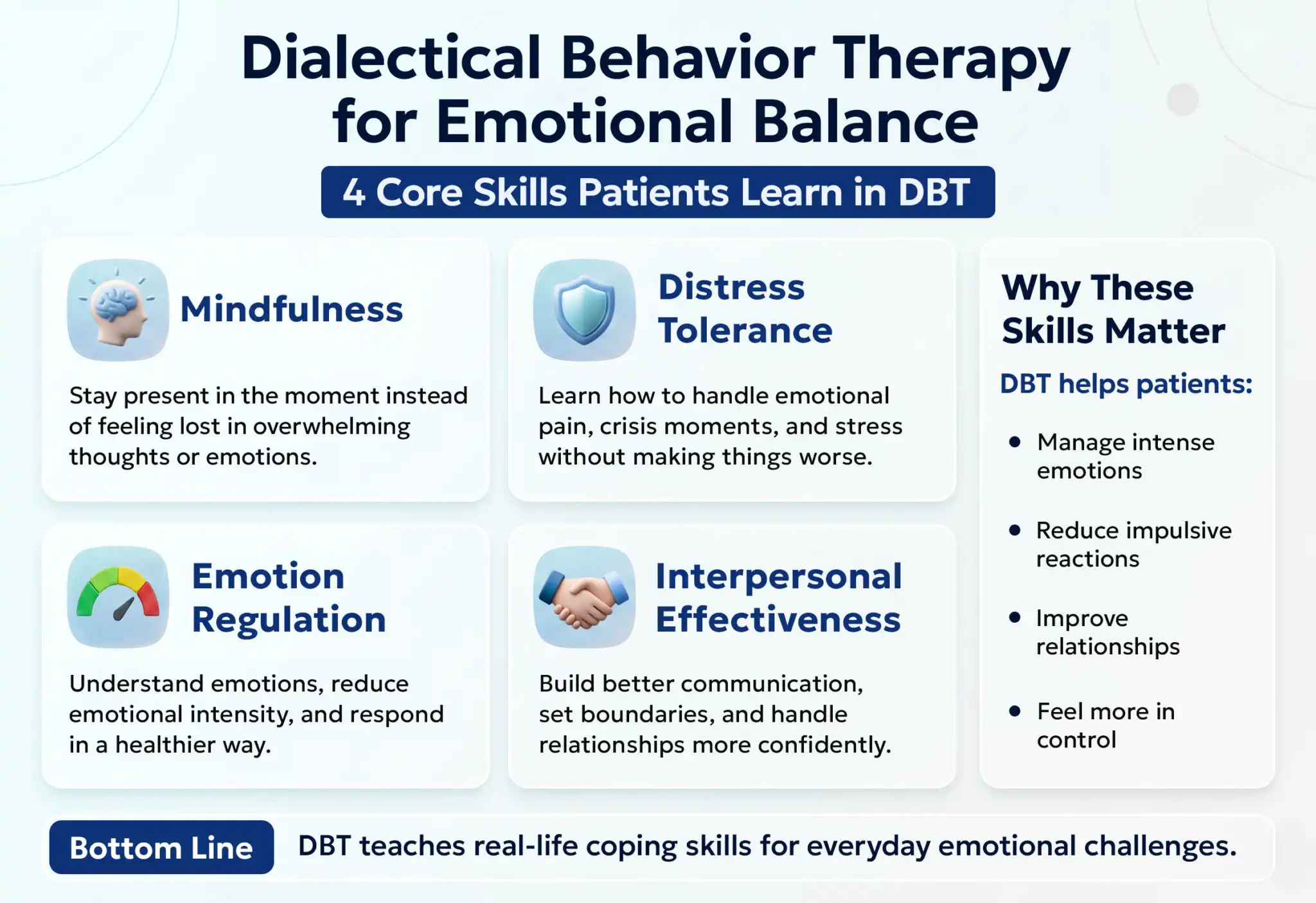
DBT centers on four major skills modules. These are the practical tools patients return to again and again.

Mindfulness:

It is the foundation. It teaches people to notice thoughts, emotions, and body sensations without immediately reacting to them. This helps create a pause between feeling something and doing something harmful.

Distress Tolerance:

It helps people get through painful moments without turning to self-harm, substance use, angry outbursts, or other impulsive behavior. The focus is not on making pain disappear instantly. It is about surviving it without adding more damage.

Emotion Regulation:

It teaches patients how to understand emotions, reduce emotional vulnerability, and respond in more constructive ways. Instead of being ruled by anger, panic, shame, or sadness, they begin to build more control over how they move through those states.

Interpersonal Effectiveness:

This focuses on relationships. Patients learn how to ask for what they need, say no, set boundaries, manage conflict, and protect self-respect while still maintaining a connection with others.

Feeling overwhelmed by your emotions? DBT can help you respond, not react

Learn practical skills to manage intense emotions, reduce impulsive patterns, and feel more in control of daily life. AZZ Medical Associates offers supportive behavioral health care with secure telehealth and structured follow-ups.

What Conditions Can DBT Help Treat?

The strongest evidence is still tied to borderline personality disorder, especially where self-injury, suicidal behavior, or severe emotional instability are present. But DBT is now used more broadly than that. The reference set consistently supports its use for depression, anxiety, PTSD, substance use disorders, eating disorders, and bipolar disorder, particularly when those conditions involve intense emotional swings or impulsive coping.

DBT may be Helpful for Patients Searching for these Conditions

  • Dialectical behavior therapy for anxiety
  • Dialectical behavior therapy for depression
  • Dialectical behavior therapy for PTSD
  • Dialectical behavior therapy for borderline
or even dialectical behavior therapy for ADHD when impulsivity and emotional reactivity are part of the clinical picture.
At AZZ Medical Associates, DBT can be especially useful when a patient does not just need insight, but also needs structured tools for emotion regulation, distress tolerance, and relationship repair.

What to Expect in DBT

A full DBT course usually asks for real commitment. Patients are often expected to attend weekly therapy, join skills training, practice between sessions, and complete homework or diary tracking. That intensity is part of the design. DBT is meant to build change in daily life, not only inside the therapy room.
That also means DBT is not the easiest therapy for everyone. Several references note that it can feel demanding, highly structured, and sometimes overwhelming at first, especially because it includes many skills and asks patients to keep working outside of session time.
Still, the same references also point to meaningful benefits: fewer self-harm behaviors, fewer hospital days, better treatment adherence, lower anger, improved depressive symptoms, and stronger quality of life over time.

You do not have to keep fighting your emotions alone.

DBT-informed care can help you understand your triggers, manage emotional overwhelm, and build healthier responses.

Dialectical Behavior Therapy vs CBT

People often confuse dialectical behavior therapy with CBT (cognitive behavioral therapy) vs dialectical behavioral therapy. The difference is important.
CBT focuses heavily on identifying and changing unhelpful thoughts and behaviors. DBT includes that foundation, but it adds more emphasis on acceptance, mindfulness, distress tolerance, and interpersonal effectiveness. In other words, DBT still works on change, but it does not assume that change alone is enough for people living with severe emotional dysregulation.
That is why DBT is often a better fit when a patient repeatedly feels overwhelmed by emotion, acts impulsively in high-stress situations, struggles with self-harm urges, or needs more structured behavioral skills than traditional talk therapy has provided.

When to Seek Professional Support for DBT

It may be time to consider DBT if emotions are becoming hard to manage, if self-harm urges or suicidal thoughts are present, if distress regularly leads to impulsive behavior, or if relationships keep breaking down under emotional pressure. It may also be worth discussing DBT if anxiety, PTSD, depression, or substance use problems are tied to repeated emotional crises rather than isolated symptoms.

Expert Insights

The Most Valuable DBT Progress Often Looks Small at First

  • Many people expect therapy progress to feel dramatic. With DBT, progress is often quieter, but clinically very meaningful.
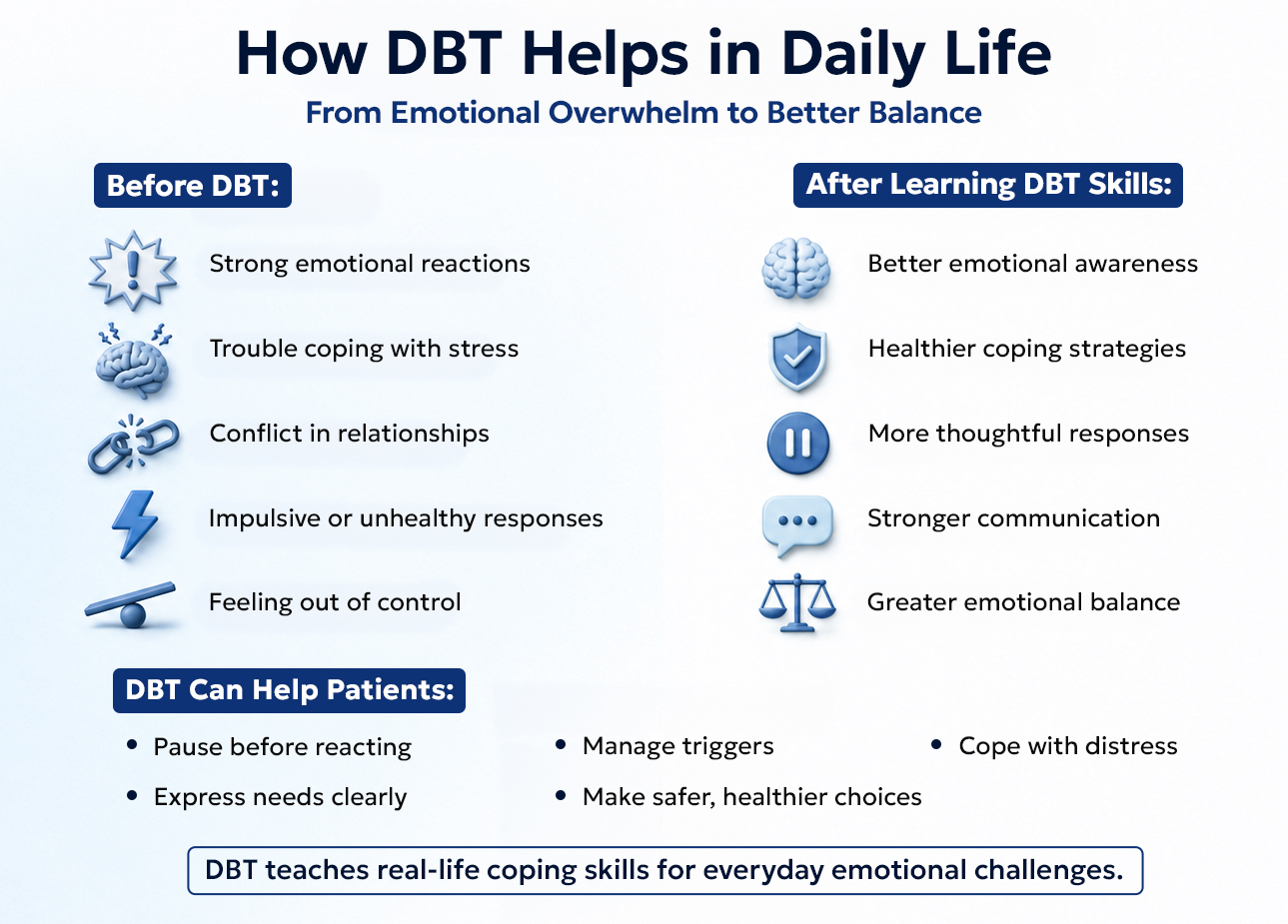
  • It may look like pausing before sending an angry message. It may look like staying present during distress instead of escaping into harmful coping.
  • It may look like recognizing a trigger earlier, asking for what you need more clearly, or getting through a difficult day without a crisis.
  • These changes matter because they reduce damage over time. DBT is built around helping people create a life that feels more manageable, more stable, and more worth living.
  • That usually happens through repeated small wins, not instant transformation. When patients understand this early, they are less likely to get discouraged and more likely to stay committed long enough to see real gains in emotional balance, relationships, and daily functioning.

Why Choose AZZ Medical Associates for DBT Treatment

At AZZ Medical Associates, dialectical behavior therapy can be part of a broader mental health plan that also includes psychiatric evaluation, medication support when appropriate, and treatment for related concerns such as anxiety, depression, PTSD, and mood instability.
  • All insurance accepted
  • No wait time in appointments
  • HIPAA-secure telehealth
  • Same-day/next-day appointments
  • Walk-in appointments
  • Medication management
  • Structured follow-ups
  • Evidence-based DBT
  • Clear communication
  • DBT skills training
  • Emotional regulation support
  • Distress tolerance coaching
  • Relationship and communication skills
  • Real-life coping strategies

When emotions feel too heavy, the right skills can change everything.

DBT helps patients build practical coping tools for stress, conflict, impulsive reactions, and painful emotional moments.

FAQs

What is Dialectical Behavior Therapy, or DBT?

Dialectical Behavior Therapy, or DBT, is a structured form of therapy that helps people manage intense emotions, reduce harmful reactions, and build healthier coping skills. It focuses on four main skill areas: mindfulness, distress tolerance, emotion regulation, and interpersonal effectiveness.

Who can benefit from DBT?

DBT may help people who struggle with emotional outbursts, impulsive behavior, relationship conflict, self-destructive patterns, anxiety, depression, trauma-related distress, or mood instability. It is often useful for patients who feel emotions very strongly and need practical tools to respond in healthier ways.

Is DBT only for borderline personality disorder?

No. DBT was originally developed for people with borderline personality disorder, but it is now also used for other mental health concerns involving intense emotions, distress, impulsivity, or relationship difficulties. Patients do not need a specific diagnosis to benefit from DBT-informed skills.

What happens during DBT treatment?

DBT usually includes structured therapy sessions where patients learn coping skills, talk through real-life situations, and practice new ways to manage emotions and relationships. Patients may also use tracking tools, such as diary cards or worksheets, to notice triggers, urges, emotional patterns, and progress between sessions.

Does AZZ offer DBT for Patients?

AZZ Medical Associates provides healthcare services in New Jersey, including primary care, psychiatry, behavioral health, and HIPAA-compliant telehealth. The site highlights an integrated approach that supports both mental and physical health, which can be helpful for patients who need coordinated care.

Can DBT be combined with medication management?

Yes. Some patients benefit from therapy, medication management, or both, depending on their symptoms and diagnosis. DBT teaches coping and emotional regulation skills, while psychiatric care may help manage symptoms such as depression, anxiety, mood instability, or other mental health conditions when medication is clinically appropriate.

How to schedule an appointment with AZZ Medical Associates?

Patients can contact AZZ Medical Associates to ask about behavioral health appointments, telehealth options, insurance, and availability. Our human support team will guide you throughout the process.

AZZ experts follow strict sourcing standards, using peer-reviewed research, academic institutions, and trusted medical journals. Only reliable, evidence-based sources are cited to maintain accuracy and integrity.

  • https://my.clevelandclinic.org/health/treatments/22838-dialectical-behavior-therapy-dbt
  • https://dialecticalbehaviortherapy.com/
  • https://dialecticalbehaviortherapy.com/
  • https://en.wikipedia.org/wiki/Dialectical_behavior_therapy
  • https://pmc.ncbi.nlm.nih.gov/articles/PMC2963469/

Search

Categories

Book an Appointment

Your healthcare starts with the right doctor. If your health raises a question, we’re here to help.
Table of Contents

Related Posts

Leaving so soon? Fill out the form and stay in touch!

Let's have a chat