Skip to content


Medically Reviewed by:
Qaisar H Usmani, MD
Read more

Why These Two “Osteo” Conditions Feel Similar
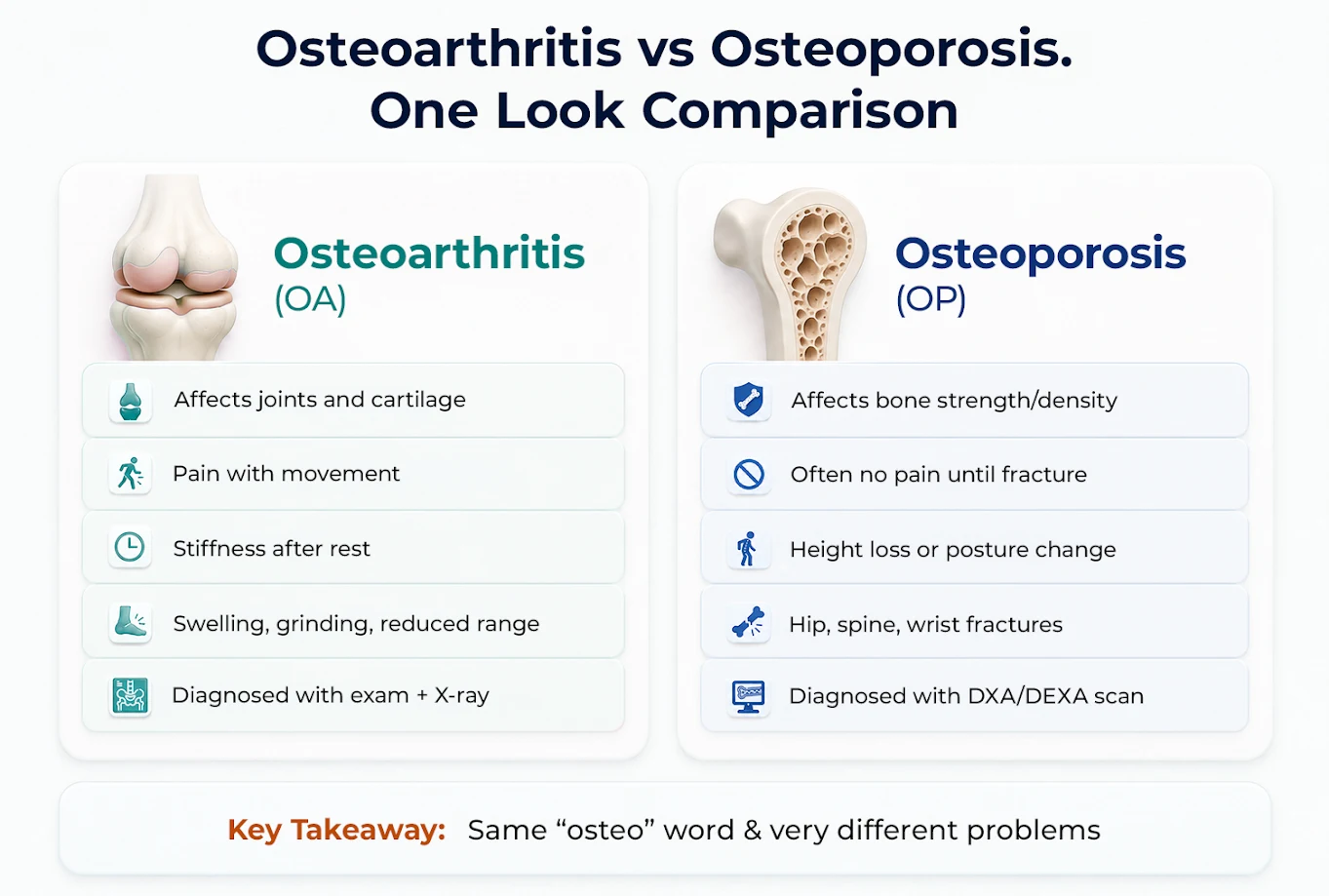
Quick Answer: Osteoporosis Vs Osteoarthritis in Plain Terms
- Osteoarthritis (OA) = damage in the joint (cartilage + surrounding structures). When cartilage thins, joints can become stiff, swollen, and painful, sometimes to the point of bone-on-bone arthritis.
- Osteoporosis (OP) = loss of bone mineral density (bones become porous/fragile). It’s often “silent” until a fragility fracture happens (hip, spine, and wrist are classic sites).
| Feature | Osteoporosis | Osteoarthritis |
|---|---|---|
| What it affects | Bones (density/strength) | Joints (cartilage + bone surfaces) |
| Core problem | Bone becomes porous/brittle | Cartilage wears down → friction, spurs |
| Typical first clue | Fracture, height loss, posture change | Pain, stiffness, swelling with use |
| Pain pattern | Often no pain until a fracture | Often pain with activity, stiffness after rest |
| Best screening test | DXA/DEXA bone density test | Exam + X-ray, sometimes MRI |
| Common overlap | Many adults can have both | Many adults can have both |
Pain Isn’t Always the Problem
Osteoarthritis (OA): A Joint/Cartilage Problem
“Osteo” Medical Term, Quick Language Decode
- Osteo– = bone (that’s the osteo medical term root)
- Arthro– = joint
- -itis = inflammation (though OA inflammation is usually lower-grade than autoimmune arthritis)
OA vs “Arthritis” (Common Confusion)
- Arthritis is a broad umbrella (100+ types).
- Osteoarthritis is one type, the common “wear-and-tear” pattern.
- A rheumatologist’s job is often to confirm whether pain is OA or something inflammatory like rheumatoid arthritis (RA), gout, psoriatic arthritis, lupus-related arthritis, etc.
Expert Insights
- Why Treating Joint Pain Without Thinking About Bone Strength Can Backfire?
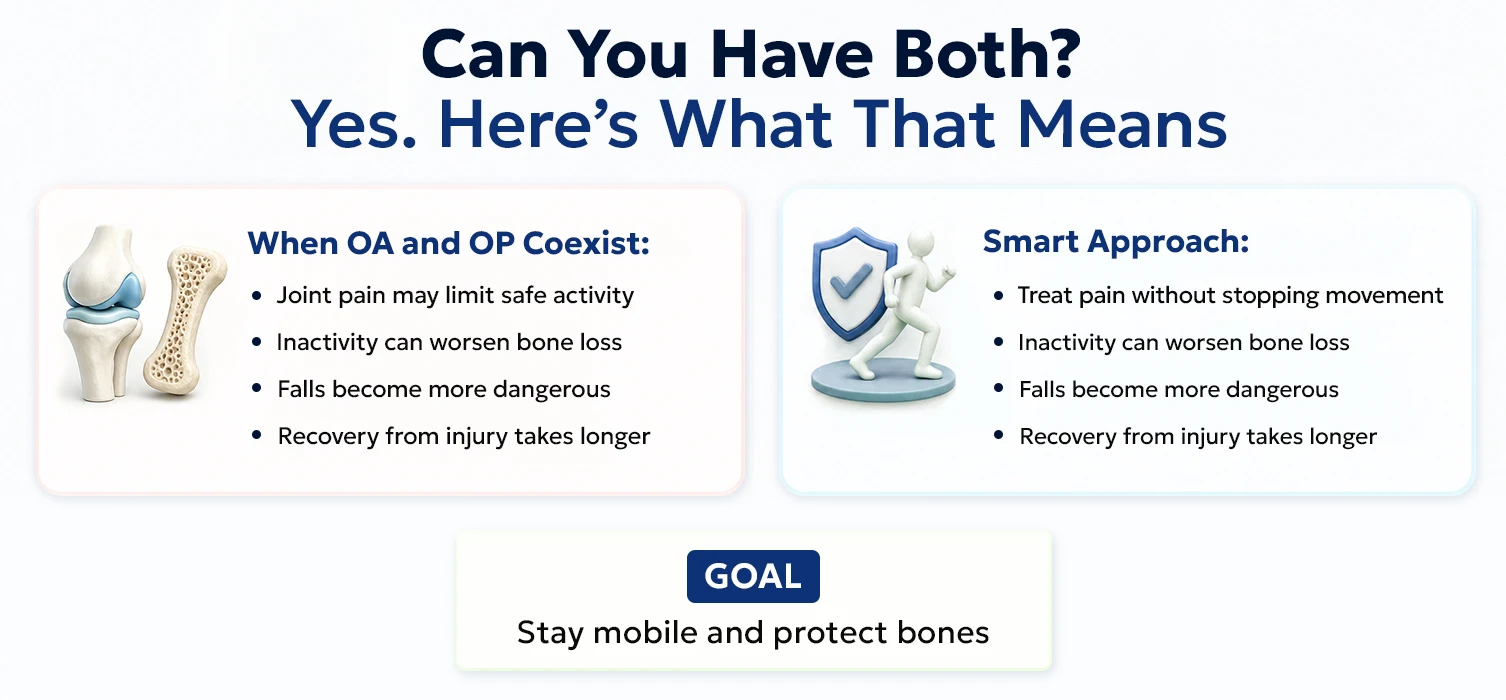
- When osteoarthritis limits movement, people naturally become less active.
- Over time, reduced weight-bearing and muscle use can accelerate bone loss.
- This creates a cycle where joint pain limits activity, and weaker bones raise fracture risk.
- Addressing both conditions together helps preserve independence and long-term mobility.
Osteoporosis (OP): a bone density problem
Don’t Guess From Pain Alone
Symptoms that Help You Tell Them Apart
“Is osteoporosis painful?” / “Does osteoporosis hurt?”
- A vertebral compression fracture (sudden mid-back pain),
- A hip/wrist fracture after a fall,
- Posture changes (kyphosis) and muscle strain around the spine.
OA Pain Tends to Behave Differently
“Porosis” meaning (why the name fits)
- Poros = porous
The medical term points to the “porous bone” concept: bone looks less dense inside, like a honeycomb that’s thinning.
- worsens with activity and improves with rest,
- comes with stiffness after sitting or in the morning,
- may include swelling/tenderness and reduced mobility.
Causes, Risk Factors, & What Does “degenerative bone disease” Mean
“How do you get osteoarthritis?”
Osteoporosis risk factors
Testing and Diagnosis: X-ray Vs MRI vs DXA/DEXA Vs Labs
What Each Test Actually Answers
| Test | Best For | What it Can Miss |
| DXA/DEXA | Osteoporosis/osteopenia risk, T-score tracking | OA cartilage wear, meniscus tears |
| X-ray | OA signs (joint space narrowing, spurs) | Early cartilage changes, subtle soft tissue injury |
| MRI | Soft tissue, cartilage, meniscus/ligaments, marrow edema | Not a screening tool for bone density |
| Labs | Rule out inflammatory arthritis, check contributing issues | OA itself often has normal labs |
Osteopenia Vs Osteoporosis & Why People Confuse It with OA
- Osteopenia = low bone mass that isn’t severe enough to meet osteoporosis thresholds.
- Osteoporosis = lower density and higher fracture risk.
Can You Have Both? What Research Says About The Overlap
Two “Shared Mechanism” Takeaways
| Shared factor | What it can do in OA | What can be done in OP |
| Inflammation + oxidative stress | Promotes cartilage breakdown and joint irritation | Can tilt balance toward bone resorption, weakening bone |
| Hormone & remodeling shifts (post-menopause, aging) | Alters cartilage and subchondral bone behavior | Accelerates bone density loss and fracture risk |
Protect Joints and Bones Together
Why Choose Us
- All insurance accepted
- No wait time in appointments
- HIPAA-secure telehealth
- Same-day/next-day appointments
- Walk-in appointments
- Preventive care
- Chronic condition management
- Coordinated Care
- In-house labs/diagnostics (where available)
- Medication management
- Structured follow-ups
- Evidence-based care
- Clear communication
Treatment Options and the Role of A Rheumatologist
- Confirming whether pain is OA vs inflammatory arthritis,
- Building a plan that protects mobility now and bone strength long-term,
- Coordinating imaging (X-ray/MRI) and bone density testing (DXA),
- Managing bone-health medications when appropriate,
- Guiding safe exercise and fall-risk reduction.
The Purpose of OA Treatment
- Activity modification and targeted physical therapy.
- Anti-inflammatory options are safe for the patient.
- Joint injections for selected cases.
- Weight management to reduce joint load.
- In severe cases, surgical consultation.
Osteoporosis Treatment Reduce the Fracture Risk
- adequate calcium and vitamin D intake (tailored to the individual),
- weight-bearing and resistance exercise (done safely),
- fall prevention (vision checks, home safety, balance training),
- medications when fracture risk is elevated (chosen by your clinician based on risk profile and medical history).
When Symptoms Overlap, Expertise Matters
Prevention Plan: Joints + Bones, One Routine
- Move daily: combine low-impact cardio (walking, cycling, swimming) with resistance training.
- Train balance: tai chi-style balance work, single-leg stands near a stable surface, heel-to-toe walking.
- Protect joints: strengthen hips/quads/core to unload knees, hips, and spine.
- Protect bones: make sure exercise includes some safe weight-bearing.
- Avoid the accelerators: smoking, heavy alcohol, prolonged inactivity.
- Reduce falls: clear tripping hazards, good lighting, proper footwear, and updated eyewear.
Closing Note
The Right Answer Changes Everything
FAQs
What’s the difference between osteoarthritis and osteoporosis?
OA is a joint/cartilage disease; osteoporosis is a bone density disease. OA causes pain with movement; osteoporosis is often silent until a fracture occurs.
Is osteoporosis the same as osteoarthritis?
No. They affect different tissues and require different tests and treatments.
Is osteoarthritis the same as arthritis?
OA is a type of arthritis. That’s why the difference between arthritis and osteoarthritis comes up so often: “arthritis” is the umbrella; OA is the most common subtype.
Which is worse: osteoarthritis or osteoporosis?
It depends. OA can be disabling from pain and stiffness; osteoporosis can be serious because fractures can be life-changing. Asking which is worse is common, but your real goal should be early diagnosis and risk reduction.
Can osteoporosis cause pain in the legs or back?
Osteoporosis itself may not hurt, but fractures can. Back pain can happen with vertebral compression fractures; leg pain can occur indirectly if posture and spine alignment change after fractures.
Does osteoporosis cause osteoarthritis (or turn into it)?
Osteoporosis doesn’t “turn into” OA. They can coexist, and reduced activity from arthritis pain can contribute to bone loss over time, so it’s smart to address both.
Does a bone density test show arthritis?
A DXA/DEXA shows bone density, not cartilage wear. Arthritis/OA is typically evaluated with an exam and imaging like X-rays (and MRI when needed).
Osteopenia vs osteoarthritis vs osteoporosis, how do I keep them straight?
- Osteopenia/osteoporosis = density (DXA categories)
- Osteoarthritis = joint/cartilage wear (X-ray/exam)