

Medically Reviewed by:
Qaisar H Usmani, MD
Read more
Publish On:
Last Updated on
- September 28, 2026

Rheumatology is the branch of medicine that diagnoses and treats rheumatic diseases: inflammatory, autoimmune, and musculoskeletal conditions affecting the joints, muscles, bones, and connective tissue, and sometimes internal organs. A rheumatologist manages these conditions with medication and monitoring rather than surgery.
While arthritis is one of the most familiar categories, rheumatology also includes systemic diseases that may affect the skin, eyes, lungs, kidneys, blood vessels, and other parts of the body. A rheumatologist evaluates, diagnoses, and medically manages these conditions using primarily non-surgical approaches.
Morning stiffness is a medical clue
Who Is a Rheumatologist & What Do They Do?
A rheumatologist is a physician who specializes in diagnosing and treating rheumatic diseases, including inflammatory arthritis, autoimmune conditions, and musculoskeletal disorders. In the United States, rheumatologists complete medical school, residency training in internal medicine or pediatrics, and advanced fellowship training in rheumatology.
Many rheumatologists pursue board certification after completing the required specialty training and examinations. They also maintain their medical knowledge through continuing education and ongoing professional development throughout their careers.
Why a Rheumatology Diagnosis May Take More Than One Visit
- Many rheumatic diseases develop gradually and may not show typical signs early on.
- Some blood tests and imaging findings may be normal or nonspecific in the early stages of rheumatic disease.
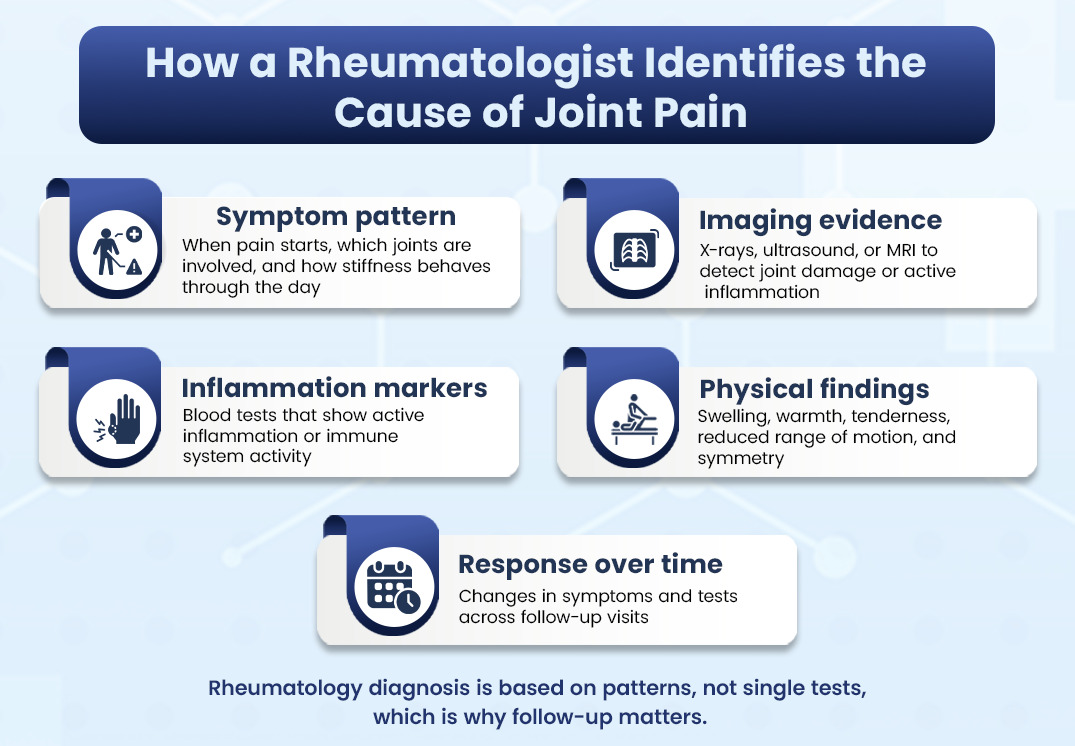
- Rheumatologists consider how symptoms change over time, physical examination findings, and whether signs of inflammation persist or develop during follow-up.
What does this mean for patients?
- A plan to monitor symptoms and reassess is not a dismissal; in some cases, it is part of reaching an accurate diagnosis.
- Follow-up visits may be important when the diagnosis remains uncertain or symptoms change over time.
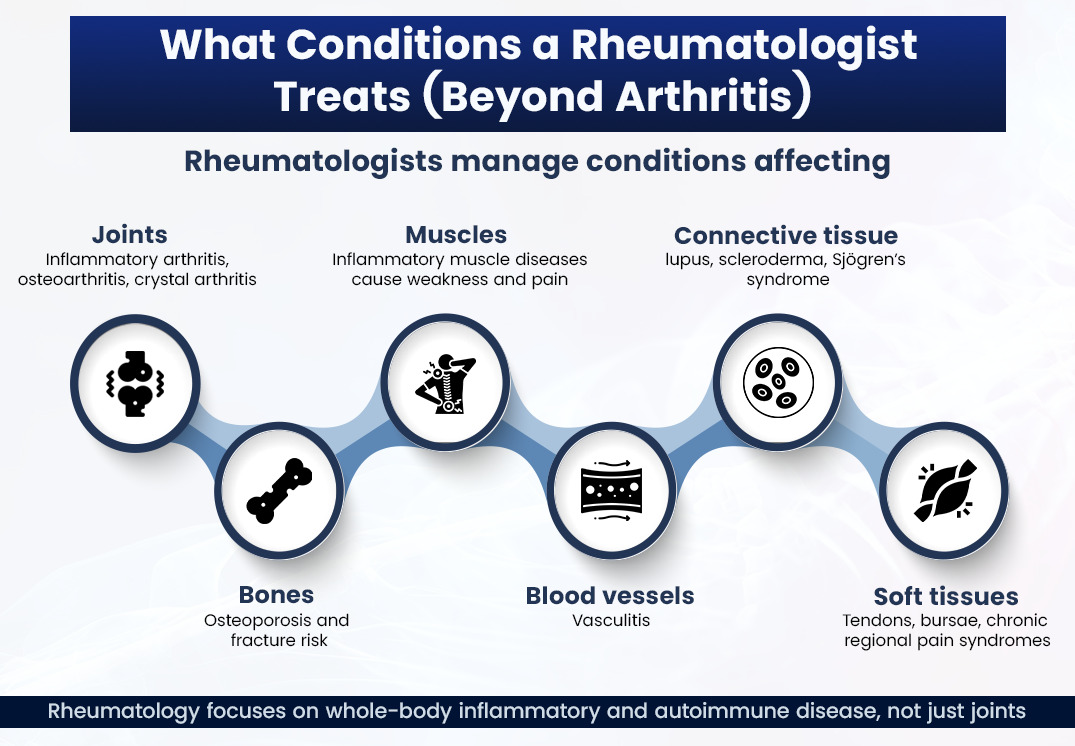
Conditions Rheumatologists Treat
- Inflammatory arthritis: rheumatoid arthritis (RA), psoriatic arthritis, & ankylosing spondylitis.
- Vasculitides and inflammatory myopathies (polymyositis, dermatomyositis).
- Degenerative disease: osteoarthritis.
- Crystal arthropathies: gout and pseudogout.
- Connective tissue and multisystem autoimmune diseases: systemic lupus erythematosus, scleroderma, and Sjögren’s syndrome.
- Metabolic bone disease: osteoporosis.
Rheumatologists may also evaluate conditions such as polymyalgia rheumatica, Raynaud’s phenomenon, fibromyalgia, sarcoidosis, tendinitis, bursitis, and persistent back pain. Giant cell arteritis may also be managed within rheumatology and requires prompt medical evaluation when suspected.
Persistent joint pain needs answers, not guesswork
How Rheumatologists Diagnose Diseases
- Review of your and your family’s medical history (timing of pain, pattern of joint involvement, systemic symptoms).
- Thorough physical examination that includes joint swelling, range-of-motion deficits, extra-articular signs, and more.
- Laboratory testing for inflammation (ESR, CRP) and disease-specific autoantibodies (ANA, RF, anti-CCP) or metabolic markers.
- Imaging, plain radiography, ultrasound, MRI, and CT as needed, to document structural change or active inflammation.
- Diagnostic procedures such as synovial fluid aspiration or tissue biopsy when clarity is required.
What to Expect at Your First Rheumatology Appointment
Expect a focused musculoskeletal exam, screening for symptoms like rashes or eye dryness, a review of your family’s autoimmune history, and orders for targeted blood work or imaging.
Learn more: What to Expect at Your First Rheumatology Appointment
Treatment (Medications, Procedures & Lifestyle)
Pharmacologic Therapy
Some biologic medications are given by injection, while others may be administered through intravenous infusion, depending on the medication and condition being treated.
- Symptomatic relief with analgesics and NSAIDs.
- If you’re experiencing a flare-up, short-term corticosteroids can help bring things under control.
- Long-term disease control with DMARDs (methotrexate, leflunomide, and sulfasalazine), biologic agents (TNF inhibitors and IL inhibitors), and targeted small molecules (JAK inhibitors), selected according to disease type and severity.
Procedures
- Joint and tendon injections, such as steroids or hyaluronic acid.
- Ultrasound or joint inspections for diagnostic clarity or symptomatic relief.
Adjuncts and Lifestyle
- Physical and occupational therapy, orthotics, and assistive devices.
- Lifestyle changes, such as exercise, weight management, a nutritious diet, quitting smoking, improving sleep, hygiene, and reducing stress.
- Regenerative options such as Platelet-Rich Plasma (PRP) therapy may be considered for certain degenerative or tendon conditions; evidence is growing and should be discussed with your clinician when appropriate.
Autoimmune symptoms often overlap
When You Should See A Rheumatologist
- Persistent joint swelling, pain, or stiffness lasting more than several weeks.
- Morning stiffness lasts an hour or longer.
- Multiple joints involved or symptoms that affect other organs (skin rash, eye pain, shortness of breath).
- Abnormal inflammatory blood tests or positive autoantibody results.
Managing rheumatic disease is about control, not just pain relief
- Pain relief alone does not stop disease progression in inflammatory or autoimmune conditions.
- Rheumatology treatment focuses on reducing immune-driven inflammation to protect joints, organs, & long-term function.
- Medications are adjusted based on disease activity, lab results, & how patients feel over time.
- What does this mean for patients:
- Regular monitoring and treatment adjustments help maintain mobility, reduce flares & prevent irreversible damage, even when symptoms feel manageable.
Working with Other Specialists for Comorbid Conditions
Rheumatology Care for New Jersey Patients
AZZ Medical Associates provides rheumatology care for patients across New Jersey through in-person and telehealth appointments. Patients can contact AZZ Medical Associates to confirm current provider availability, appointment options, and the most appropriate type of visit for their needs.
Patients may seek rheumatology evaluation for persistent joint pain, inflammatory arthritis, autoimmune conditions, gout, lupus, osteoporosis, and other rheumatic diseases. Whether an in-person or telehealth visit is appropriate depends on your symptoms, examination needs, and treatment plan.
For current rheumatology providers, locations, telehealth options, and appointment availability, visit our Rheumatology Services in New Jersey page.
Why Choose AZZ Medical Associates for Rheumatology Care
AZZ Medical Associates combines rheumatology evaluation, diagnostic coordination, treatment planning, and ongoing follow-up to support patients with inflammatory, autoimmune, and musculoskeletal conditions.
Depending on your condition and treatment needs, rheumatology care may include:
- Evaluation of persistent joint pain, swelling, and stiffness
- Assessment of suspected inflammatory or autoimmune disease
- Laboratory and imaging coordination
- Medication management
- Monitoring of disease activity and treatment response
- Joint-related procedures when clinically appropriate
- Coordination with primary care physicians and other specialists
- Referrals to additional specialists when needed
- In-house laboratory or diagnostic services where available
- Ongoing follow-up for chronic rheumatic conditions
Care plans are individualized based on the diagnosis, symptoms, medical history, treatment response, and overall health needs of each patient.
Takeaways
Treatment works best when started early
FAQs
What is rheumatology?
Rheumatology is the medical specialty focused on diagnosing and treating rheumatic diseases, including inflammatory arthritis, autoimmune conditions, and musculoskeletal disorders that can affect the joints, muscles, bones, connective tissues, and sometimes internal organs.
What does a rheumatologist do?
A rheumatologist evaluates symptoms, reviews medical history and test results, performs a physical examination, orders laboratory tests or imaging when needed, diagnoses rheumatic diseases, develops treatment plans, and monitors disease activity over time.
What conditions does a rheumatologist treat?
Rheumatologists treat conditions such as rheumatoid arthritis, psoriatic arthritis, lupus, gout, ankylosing spondylitis, Sjögren’s syndrome, scleroderma, vasculitis, osteoarthritis, osteoporosis, and other inflammatory, autoimmune, and musculoskeletal conditions.
When should you see a rheumatologist?
You may need a rheumatology evaluation if you have persistent joint pain, swelling, prolonged morning stiffness, symptoms affecting several joints, unexplained fatigue with joint symptoms, recurring inflammation, or signs that may suggest an autoimmune disease.
Why would a doctor refer you to a rheumatologist?
A doctor may refer you to a rheumatologist when symptoms, examination findings, blood tests, or imaging suggest an inflammatory, autoimmune, or rheumatic condition that requires specialist evaluation.
What happens at your first rheumatology appointment?
A first rheumatology visit usually includes a detailed review of your symptoms and medical history, a physical examination, review of previous test results, and discussion of whether additional blood tests or imaging are needed.
What tests does a rheumatologist perform?
Depending on your symptoms, a rheumatologist may order blood tests such as ESR, CRP, ANA, rheumatoid factor, or anti-CCP, as well as X-rays, ultrasound, MRI, CT scans, bone-density testing, or joint-fluid analysis.
What is the difference between a rheumatologist and an orthopedist?
A rheumatologist primarily diagnoses and treats inflammatory, autoimmune, and systemic musculoskeletal diseases using nonsurgical treatments. An orthopedist focuses on musculoskeletal injuries, structural problems, and degenerative conditions and may perform surgery when needed.
Does a rheumatologist treat autoimmune diseases?
Yes. Rheumatologists diagnose and manage many systemic autoimmune diseases, including rheumatoid arthritis, lupus, Sjögren’s syndrome, scleroderma, vasculitis, and inflammatory muscle diseases.
Can rheumatic diseases be cured?
It depends on the condition. Many rheumatic diseases are chronic and cannot currently be cured, but treatment can often reduce inflammation, control symptoms, preserve function, and help prevent complications or disease progression.