

This isn’t because ADHD is rarer in girls and women. Most research shows no significant difference in the actual type, number, or severity of symptoms between the sexes. What differs is how those symptoms show up, how visible they are to the people around the person, and how the diagnostic system, built largely around the male presentation, was ever set up to catch them in the first place.
Why Diagnosis Rates Differ So Much Between Sexes
The numbers here are striking. Most estimates put the male-to-female diagnosis ratio in childhood at around 2 to 1, though some studies have found ratios as skewed as 17 to 1 depending on the population studied. By adulthood, that gap narrows considerably, largely because women are far more likely to finally receive a diagnosis later in life.
That narrowing isn’t evidence that women suddenly develop ADHD in adulthood. It reflects a pattern of underdiagnosis catching up with itself. Research suggests the higher male-to-female ratio shows up strongly in clinical samples, meaning people who actually get referred for evaluation, but far less strongly in general population samples. That gap points to a bias in who gets noticed and referred in the first place, not necessarily in who actually has the condition.
Expert Insights
A 2018 study found that the higher male-to-female ADHD diagnosis ratio appears in clinical samples but not in general population samples, suggesting a sex bias in the diagnostic referral process itself.
How ADHD Symptoms Differ in Men and Boys
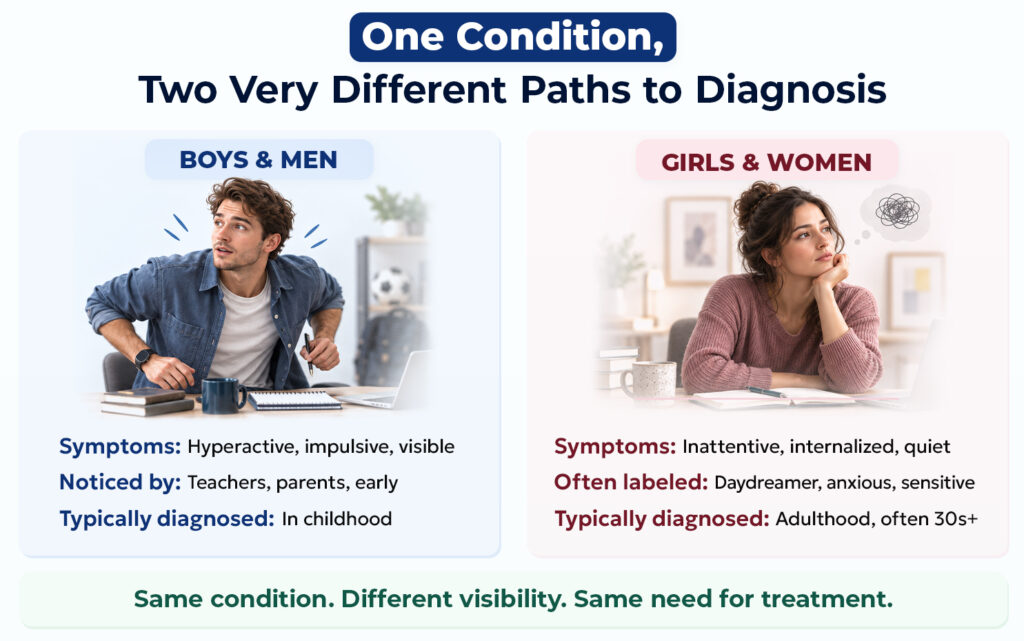
Boys and men with ADHD more often show externalizing symptoms, the outwardly visible kind that draw attention from teachers, parents, and eventually employers.
- Hyperactivity and physical restlessness that are hard to miss in a classroom or meeting
- Impulsivity that shows up in ways others notice immediately: interrupting, acting without thinking, difficulty waiting
- Symptoms that tend to be more observable to caregivers and teachers, which is part of why boys are referred for evaluation more often
- As men move into adulthood, hyperactivity typically diminishes, while difficulty with time management and executive function becomes more prominent
Because these symptoms conform to what most people already expect ADHD to look like, they tend to trigger a faster path to diagnosis.
How ADHD Symptoms Differ in Women and Girls
Women and girls more frequently present with internalizing symptoms, the kind that don’t disrupt a classroom or a meeting but quietly disrupt the person experiencing them.
- Inattention and distractibility without significant hyperactivity
- Executive dysfunction and emotional dysregulation, difficulties that aren’t part of the official diagnostic criteria but are strongly associated with female ADHD presentation
- Body-focused repetitive behaviors, including skin picking, hair pulling, leg bouncing, or cuticle picking
- Deep emotional responses, including crying, anger, guilt, and shame that feel disproportionate to the situation
- Shyness or social withdrawal linked to social anxiety and sensory sensitivity
- An internal sense of impairment that’s difficult to explain to others and easy to misread as a personality trait rather than a symptom
Because inattentive symptoms are quieter and less disruptive to the people around them, they’re far easier to overlook, both by teachers and parents in childhood and by clinicians in adulthood.
Dismissed as "Just Scattered" for Years?
That pattern has a name, and it’s treatable.
Why ADHD Is Missed More Often in Women
Several factors compound to push female ADHD under the radar for years, sometimes decades.
- Symptom visibility. Hyperactive and impulsive symptoms are simply easier to notice than inattentive ones, and boys present more often with the former.
- Social expectations. ADHD-linked behaviors, especially hyperactivity and impulsivity, have historically been considered more socially acceptable in boys and men. Girls often learn early to suppress or mask similar behaviors to fit in.
- Diagnostic bias baked into the criteria. Diagnostic criteria were developed largely from research on male, hyperactive presentations, which means the female presentation was never fully represented in what clinicians were trained to look for.
- Masking that works, for a while. Women who develop coping or masking strategies may genuinely feel capable of handling routine situations and won’t report symptoms unless asked open-ended, specific questions during an evaluation.
- Co-occurring conditions stealing the diagnostic spotlight. Women with ADHD are more likely to also have depression, anxiety, or an eating disorder, and these frequently get diagnosed and treated first, masking the ADHD underneath.
What Causes ADHD in Both Sexes
The underlying causes of ADHD are the same regardless of sex.
- Genetics. ADHD has a strong hereditary link. A parent with ADHD significantly raises the likelihood of a child developing it, and this holds true across sexes.
- Brain-based differences. Evidence points to differences in brain structure, chemistry, or both, in people with ADHD, though researchers are still working out the full picture.
- Neurodevelopmental origin. People with ADHD are neurodivergent, meaning their brains develop and function differently from neurotypical brains, not as a deficiency but as a genuine variation.
What differs by sex isn’t the root cause. It’s how sex-based hormones and biological characteristics may interact with that underlying neurology to shape how symptoms present and evolve over a lifetime.
The Role of Hormones in Female ADHD
This is one of the clearest, most consistent differences between how ADHD affects women versus men, and it’s an area where treatment considerations genuinely diverge.
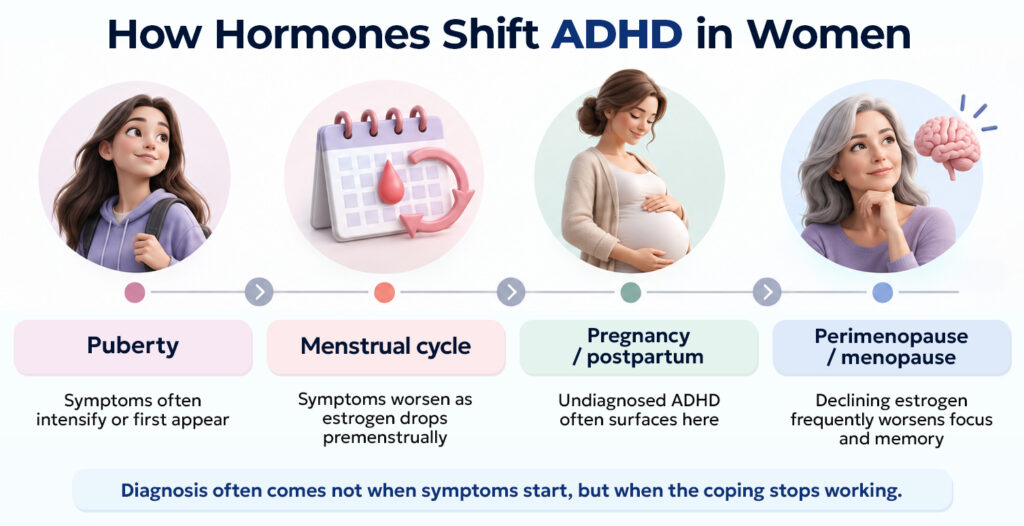
- Menstrual cycle. Estrogen and progesterone rise following menstruation, generally supporting cognitive function. As premenstrual hormone levels drop, ADHD symptoms tend to worsen alongside typical premenstrual changes, sometimes closely resembling PMDD.
- Puberty. Hormonal shifts beginning at puberty can intensify ADHD symptoms and are a common point where symptoms first become noticeable, or first become disruptive enough to prompt evaluation.
- Pregnancy and postpartum. Some women who were never diagnosed in childhood first recognize their ADHD symptoms during pregnancy or after childbirth, when the demands of caring for an infant expose difficulties that had previously gone unnoticed.
- Perimenopause and menopause. As estrogen and progesterone decline significantly, ADHD symptoms frequently intensify. Combined with normal age-related cognitive changes, this can bring worsening confusion, memory difficulty, and sleep disruption.
- Testosterone in men. Higher testosterone levels in males may have a protective effect against certain ADHD-related cognitive difficulties, one possible contributor to why symptom trajectories differ between the sexes.
Because women spend roughly a third of their lives after menopause, and because so little research has historically focused on this stage, the hormone-ADHD relationship in later life remains an area where the science is still catching up.
Co-Occurring Conditions by Sex
ADHD rarely travels alone, and which conditions tend to accompany it also differs somewhat by sex.
- In women: Higher rates of co-occurring depression, anxiety, and eating disorders, any of which can mask underlying ADHD and delay accurate diagnosis for years.
- In men: Externalizing patterns are more common alongside ADHD, including higher rates of conduct-related difficulties and substance use concerns.
- Across both: Co-occurring conditions complicate diagnosis regardless of sex, since treating the visible condition, anxiety, depression, or behavioral issues, can obscure the ADHD driving it underneath.
How ADHD Changes Across the Lifespan
- Childhood: Boys more often show hypermotoric, impulsive behavior. Girls more often show quiet inattention that reads as daydreaming rather than a symptom.
- Adolescence: Hormonal changes in girls can intensify symptoms right as academic and social demands increase, a combination that often goes unrecognized as ADHD-related.
- Adulthood: Hyperactive and impulsive symptoms tend to decrease for both sexes, while internalizing symptoms, particularly emotional dysregulation, tend to increase. This shift is more pronounced in women, who report more internalizing symptoms than men across both childhood and adulthood.
- Later adulthood: Men’s presentation tends to stabilize around executive function and time management struggles. Women’s presentation often continues shifting with reproductive hormone changes, particularly through perimenopause and menopause.
Never Diagnosed Because You Coped Too Well?
How Diagnosis Differs by Sex
Diagnosing ADHD in women and girls often requires a different clinical approach than the traditional model built around observable hyperactivity.
- Open-ended, specific questioning. Because masking is so common in women, structured but open-ended interview questions are more likely to surface genuine symptom patterns than a standard checklist alone.
- Awareness that masking can hide real impairment. A woman who appears to be coping well in a clinical interview may still meet full diagnostic criteria; masking effectiveness isn’t the same as absence of symptoms.
- Attention to hormonal timing. Since symptoms can fluctuate across the menstrual cycle, puberty, pregnancy, and menopause, understanding where a patient is in that timeline is relevant clinical context.
- Looking past a co-occurring diagnosis. When anxiety, depression, or an eating disorder is already present, a thorough evaluation asks whether ADHD might be the underlying driver rather than assuming the visible diagnosis is the whole story.
Wondering If This Explains a Lifelong Pattern?
Symptoms that were always dismissed as “just how you are” deserve a proper evaluation, at any age.
Treatment Considerations for Men vs. Women
Most evidence suggests medication efficacy itself doesn’t differ meaningfully by sex, but a few sex-specific factors are worth building into a treatment plan.
- Hormonal timing and stimulant response. Fluctuating estrogen and progesterone levels across the menstrual cycle may influence how effective stimulant medication feels at different points in the cycle, an area researchers say needs further study but that many women notice clinically.
- Treating co-occurring conditions alongside ADHD, rather than instead of it, particularly for women where anxiety, depression, or disordered eating frequently overlap.
- Monitoring through major hormonal transitions, including puberty, pregnancy, postpartum, and menopause, since symptom severity and treatment needs can shift during each.
- Addressing years of masking, which is more common in women and can mean treatment needs to include unlearning compensatory habits that have become exhausting to maintain, not just managing symptoms going forward.
Across both sexes, the most effective approach generally combines medication with behavioral strategies or therapy, adjusted to the individual’s actual presentation rather than a generic protocol.
When to Seek an Evaluation
Consider an evaluation if:
- You were dismissed as “spacey,” “scattered,” or “not trying hard enough” for years without anyone raising ADHD as a possibility
- Symptoms noticeably worsen around your menstrual cycle, pregnancy, postpartum, or perimenopause
- You’ve been treated for anxiety, depression, or an eating disorder without full resolution of how you feel
- A close relative has ADHD, and patterns in your own life sound familiar
- Inattention, disorganization, or emotional overwhelm is affecting work, relationships, or daily functioning, regardless of how well you’ve compensated so far
When to Seek Urgent Support
ADHD Care in New Jersey
Primary care is a reasonable starting point for adults or parents in New Jersey concerned about ADHD, particularly presentations that have been missed or misattributed for years. A provider can review history, current symptoms, and any co-occurring conditions, then determine the right next step.
Telehealth for ADHD Care
AZZ Medical Associates offers telehealth appointments across New Jersey for many ADHD-related visits, including evaluations, follow-ups, and medication management. Your provider can help determine whether your specific situation is better suited to a video visit or an in-person appointment.
ADHD Care at AZZ Medical Associates
AZZ Medical Associates provides ADHD evaluation and treatment for both women and men across New Jersey, with attention to how differently the condition can present depending on sex, age, and hormonal stage.
Services relevant to this include:
- Primary Care
- Pediatric Care
- Behavioral Health Services
- Medication Management
- Preventive Care
- Telehealth
Service availability and provider scheduling may vary by location. Confirm availability with your preferred AZZ Medical Associates clinic.
Never Been Properly Evaluated for ADHD?
Whether symptoms were missed in childhood or have shifted with age or hormones, it’s not too late to get answers.
How to Prepare for an Appointment
- A written history of symptoms, including anything dismissed in childhood as a personality trait
- Notes on whether symptoms fluctuate with your menstrual cycle, pregnancy, or menopause, if applicable
- Any prior diagnoses or treatment for anxiety, depression, or an eating disorder
- Family history of ADHD, including relatives who were never formally diagnosed
- Insurance information
Lifestyle & Supportive Approaches
- Tracking symptom patterns against hormonal cycles, where relevant, to give your provider useful context
- Building external structure, reminders, routines, that supports focus without becoming exhausting to maintain
- Addressing co-occurring anxiety, depression, or disordered eating as part of the same overall plan, not a separate issue
- Allowing space to unlearn masking habits that have stopped being helpful, rather than adding more coping strategies on top
Takeaway
ADHD doesn’t discriminate by sex, but the healthcare system historically has. Boys and men tend to get noticed early because their symptoms are loud. Girls and women often go unnoticed for decades because their symptoms are quiet, internalized, and easy to mistake for something else entirely, anxiety, a personality trait, or simply being “too sensitive.”
Recognizing how differently ADHD can show up is the first step toward closing that gap, whether that means catching it earlier in a daughter who’s being called a daydreamer, or finally getting answers as an adult who’s spent a lifetime wondering why everything felt harder than it should.
FAQs
Is ADHD actually more common in men, or just diagnosed more often?
The evidence points more toward underdiagnosis in women than a true difference in prevalence. Diagnosis ratios are far more skewed in clinical samples than in general population studies, suggesting a bias in who gets referred and evaluated.
Why are women diagnosed with ADHD later in life than men?
Women more often present with inattentive, internalized symptoms that are easier to miss, and they're more likely to be diagnosed first with anxiety, depression, or an eating disorder, which can delay recognition of the underlying ADHD.
Do hormones actually affect ADHD symptoms?
Yes. Estrogen and progesterone fluctuations across the menstrual cycle, pregnancy, and menopause are associated with changes in ADHD symptom severity in women. Testosterone in men may offer some protective cognitive effect, though more research is needed.
Does ADHD medication work differently in women than men?
Overall effectiveness appears similar, but fluctuating hormone levels across the menstrual cycle may influence how well stimulant medication works at different points in the cycle, an area still being researched.
Can ADHD symptoms get worse during menopause?
Yes. As estrogen and progesterone decline during perimenopause and menopause, many women experience a worsening of ADHD symptoms, often alongside increased memory and concentration difficulties.
Is it too late to get diagnosed with ADHD as an adult woman?
No. Many women are diagnosed for the first time in their thirties, forties, or later, often after years of symptoms being attributed to anxiety, stress, or personality. A proper evaluation is worthwhile at any age.
Why do boys get diagnosed with ADHD more often in childhood?
Boys more frequently show hyperactive and impulsive symptoms, which are more visible and disruptive to teachers and parents, making them more likely to be referred for evaluation than children showing quieter, inattentive symptoms.