
Medically Reviewed by:
Farhat Nageen, MD
Read more
Publish On:
Last Updated on
- October 30, 2026

Your child will see the pediatrician about 30 times before turning 21, and many of those visits happen when they’re feeling perfectly healthy. Wellness visits for your child will be scheduled according to a plan by the American Academy of Pediatrics (AAP).
Every visit has its own purpose. Your pediatrician will monitor your baby’s physical and mental development, administer all necessary vaccinations, and screen for conditions like anemia, lead poisoning, vision and hearing problems, and depression at the times they may occur. Wellness visits will also give you a chance to discuss things related to sleep, nutrition, behavior, or school separately.
What Is a Pediatric Wellness Visit?
A pediatric wellness visit, which is also known as a well-child examination or well-child checkup, is an appointment that is done in order to monitor the growth and development of the child. It is used to identify any possible problem before it becomes serious, provide immunization updates, and give parents advice for the next stage of childhood.
How Often Should Children Have Wellness Visits?
Children should have a wellness visit at 3 to 5 days old; at 1, 2, 4, 6, 9, 12, 15, 18, 24, and 30 months; and then once a year from age 3 through 21. This schedule comes from Bright Futures, the AAP’s guideline for preventive pediatric care.
Age | Recommended wellness visits |
Newborn | 3 to 5 days after birth |
Infancy | 1, 2, 4, 6, 9 and 12 months |
Toddlers | 15, 18, 24 and 30 months |
Preschool years | Every year at ages 3, 4 and 5 |
School-age children | Every year from ages 6 to 12 |
Adolescents and young adults | Every year from ages 13 to 21 |
Your child’s provider may add visits if your child needs closer follow-up.
Not Sure If Your Child Is Due for a Checkup?
Our pediatric team will review your child’s records, request files from a previous office if needed, and check for any missed vaccines.
What Happens at a Wellness Visit, Age by Age
Wellness visits involve taking a medical history and answering your questions, measurements of growth, physical examination, evaluation of development and behavior, vaccines or tests that are due, and advice regarding feeding, sleeping, and safety. All these components are not provided for every child during every visit, since every visit is individualized depending on the age and condition of the child.
The same rule applies to vaccination. Vaccines depend on age, health history, and doses taken before; therefore, be sure to provide information about immunizations your child received earlier. According to AAP, you should ask your pediatrician about any questions concerning immunization.
Every time your child comes to see his or her provider, the latter pays attention to the child’s movements, speech, play, and social interaction. It is called developmental surveillance. At some ages, the provider uses a standardized questionnaire that is usually completed by a parent. It is called developmental screening.
Newborns and Infants (Birth–12 Months)
The 3–5 day checkup evaluates your baby’s feeding, weight, and jaundice. Throughout the first year of pediatric care, your baby’s weight, length, and head circumference are measured and plotted on a growth chart. The AAP also recommends screening the birth parent for postpartum depression at the 1, 2, 4, and 6-month visits.
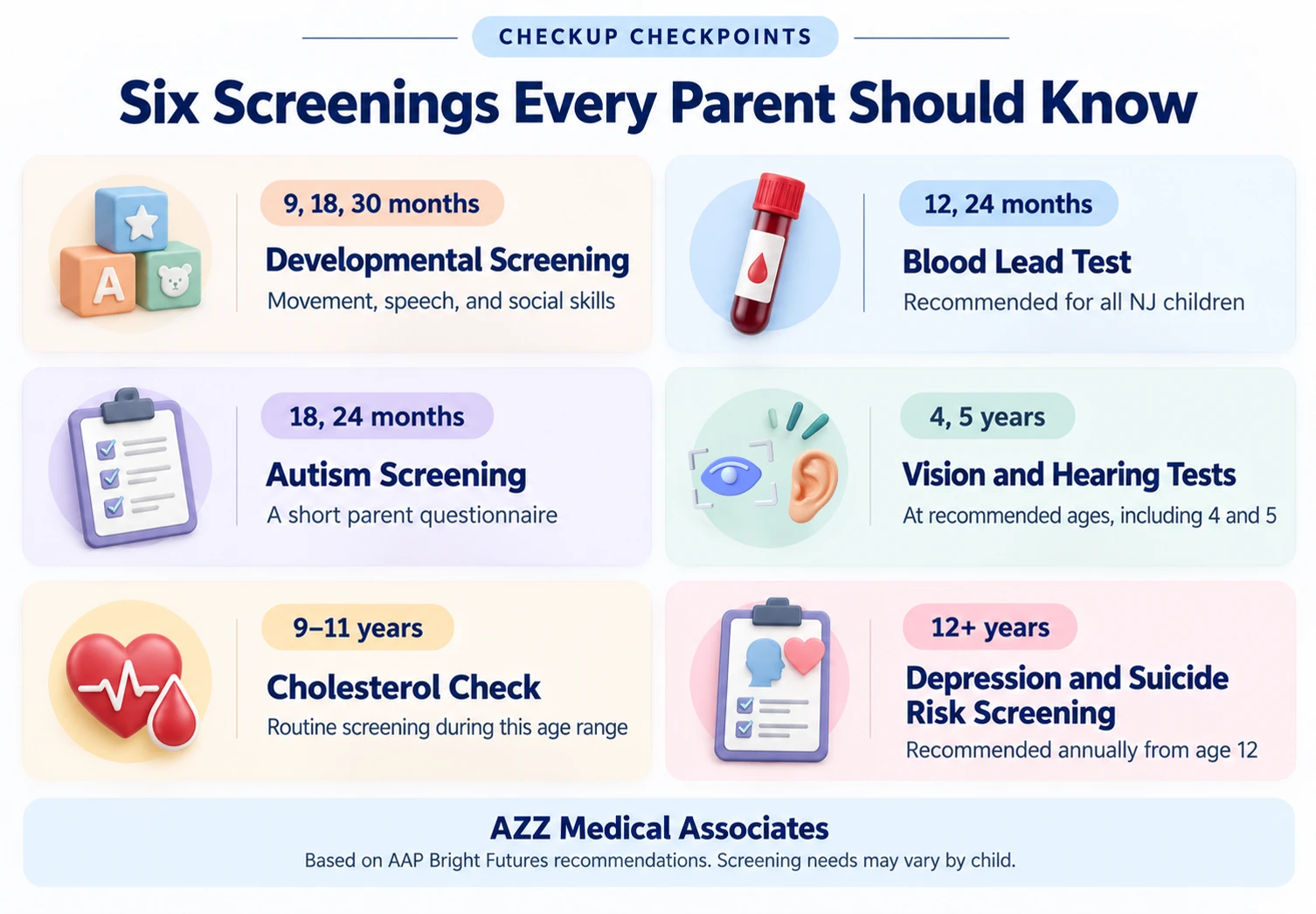
At 9 months, your child has their first developmental screening. At 12 months, your pediatric care provider checks for anemia and lead exposure and asks whether your child has a dentist. The New Jersey Department of Health advises a blood lead test at both 12 and 24 months.
Toddlers and Preschoolers (1–5 Years)
Toddler health checkups cover the development of walking, talking, playing, and behavior. Developmental screening happens at 18 and 30 months, and autism screening at 18 and 24 months.
Blood pressure testing is performed annually starting at age 3, vision and hearing tests are done at appropriate ages, including ages 4 and 5, and BMI is assessed starting from age 2.
School-Age Children (6–12 Years)
Annual school-age exams include evaluation of growth, blood pressure, eyesight, schooling, sleep, and physical activity. School-age issues that are worthy of discussion are problems with learning or paying attention, including potential ADHD problems in children.
AAP recommends a cholesterol screening once between ages 9 and 11. Vaccinations at age 11 to 12 are usually scheduled; New Jersey requires Tdap and meningococcal ACWY vaccines for students entering grade 7 or higher, with qualifying doses given at age 10 or older.
Teenagers (13–21 Years)
Teen appointments consist of an annual screening for depression and suicide risk, which starts at age 12, and questions about smoking, alcohol, and drug use, which start at age 11. Furthermore, the AAP recommends HIV screening at least once between the ages of 15 and 21, and another screening for cholesterol between the ages of 17 and 21.
If your teen participates in any school sports team, make sure you bring the New Jersey Preparticipation Physical Evaluation form to the appointment. The sports physical needs to be completed within 365 days prior to the first practice, so the yearly wellness appointment is a good time to do it.
During the teen appointment, your child’s provider will spend some time with your teenager alone. According to the AAP, teens are more willing to talk openly without the presence of their parents and get accustomed to taking care of themselves. If your teen is experiencing stress, anxiety, or other mental health issues, AZZ behavioral health services are available in addition to your teen’s appointments.
How to Prepare for Your Child's Wellness Visit
Bring the items below, and write down your top three to five questions. The AAP suggests raising them at the start of the visit, and topics such as development, behavior, sleep, eating, and how your child gets along with family are all worth bringing up.
- Insurance card and your child’s vaccination record
- Medicines, supplements, and allergies list
- School, sports, camp, or daycare forms
- Information about any sleep, appetite, behavior, or developmental changes since the previous visit
- Medical history updates including any recent diagnoses among close relatives
Missed a Checkup? It’s Easy to Catch Up
Bring your child’s medical and vaccination records so the provider can review previous screenings, vaccines, and any follow-up needs.
What Happens After a Wellness Visit?
The visit will usually end with a plan: any actions that need follow-up, guidance about the coming months, and a date for the next visit.
Screening outcomes: The screening itself is not a diagnosis. In case of an outcome requiring additional actions, the health care provider of your child may conduct additional screenings, request more testing, and/or refer your child to a specialist, for example, a pediatric developmental expert, a hearing specialist, or an eye doctor.
Developmental concerns under age 3: If either a screening or your personal observation leads to concerns regarding the development of your baby or toddler, NJ Early Intervention System assists parents with developmental concerns of their children under 3 years of age.
Between visits: Note all new information about your child’s speech, sleeping patterns, behavior, or growth and present it at the next wellness visit. Call earlier if concerned; there is no need to wait until the next wellness visit.
Pediatric Wellness Care in New Jersey
AZZ Medical Associates provides pediatric care at select New Jersey locations, including routine well-child checkups, growth monitoring, developmental screening, immunizations, and preventive care from birth through age 18. Telehealth can help with some follow-up questions, but routine wellness checkups need an in-person exam.
Pediatric Wellness Care Across New Jersey
We track your child’s vaccines against NJ school entry requirements and accept all insurance, including NJ FamilyCare.
Final Thoughts
Pediatric wellness visits are about more than checking boxes. They give you a regular, planned time to see how your child is growing, catch concerns early, and keep their care on track from infancy through the teen years. Knowing what each stage involves makes these visits easier to plan and helps you walk in prepared.
Whether your child is due for their first checkup or their next annual visit, staying consistent is what makes the biggest difference over time. If it has been a while, or you’re unsure what comes next, reach out to your child’s provider. AZZ Medical Associates is here to help keep your child healthy at every stage.
Frequently Asked Questions
Is a well-child check the same as a physical?
Not exactly. A well-child visit will include a physical examination; however, it also involves growth and development, behavioral issues, screening tests, immunizations, and education for parents. In contrast, a school physical and a sports physical are more specific.
What is the difference between a sick visit and a well visit?
A well visit is planned to check your child's overall health and prevent problems. A sick visit is booked when your child has a specific problem, such as a fever or ear pain, and focuses on treating it.
How long should a well-child visit take?
In a national survey of parents published in Pediatrics, nearly half said their child's most recent well-child visit lasted 11 to 20 minutes with the clinician, while about a third said it was shorter. Plan extra time for check-in, questionnaires, and any vaccines.
Is the well-child visit schedule the same as the vaccination schedule?
No. The well-child visit schedule, the AAP's Bright Futures schedule shown above, sets when checkups happen. The vaccination schedule sets which vaccines are due at each age, and many of them are given during those checkups. Ask your child’s provider which vaccines are due based on your child’s age, health history, and previous doses.
How much does a well-child visit cost?
All Marketplace health plans and many other plans must cover well-child visits and many children's screenings at no cost when you see an in-network provider, though $0 isn't guaranteed in every case. Without insurance, prices vary by practice, so ask the office before the visit.
At what age do you stop doing well-child checks?
The AAP schedule continues once a year through age 21. Many young adults then move to an adult primary care provider. At AZZ, pediatric care continues through age 18.