

High-functioning ADHD” is not a term you’ll find in a diagnostic manual. There is no separate checklist for it, no specifier a clinician circles on a form. And yet the phrase resonates with an enormous number of people, especially adults who have spent years excelling on the outside while quietly struggling on the inside.
The person this term describes rarely presents as disruptive. They meet deadlines, hold down demanding jobs, raise kids, and look, from the outside, entirely put together. What the label misses is the cost of getting there. Behind a functioning exterior often sits obsessive checklists, compulsive rechecking, hyperfocus sessions that stretch into the night, and a level of mental effort that has nothing to do with how things look on paper.
Whether someone is “high-functioning” isn’t really about how much ADHD is present. It’s about how well the coping strategies are currently holding, and how long they can keep holding before something gives.
What Does "High-Functioning ADHD" Actually Mean?
High-functioning ADHD is an informal, non-clinical term describing people who meet the diagnostic criteria for ADHD but have developed coping mechanisms effective enough to maintain success at work, school, or home. It is not a separate type of ADHD and does not appear anywhere in the DSM-5.
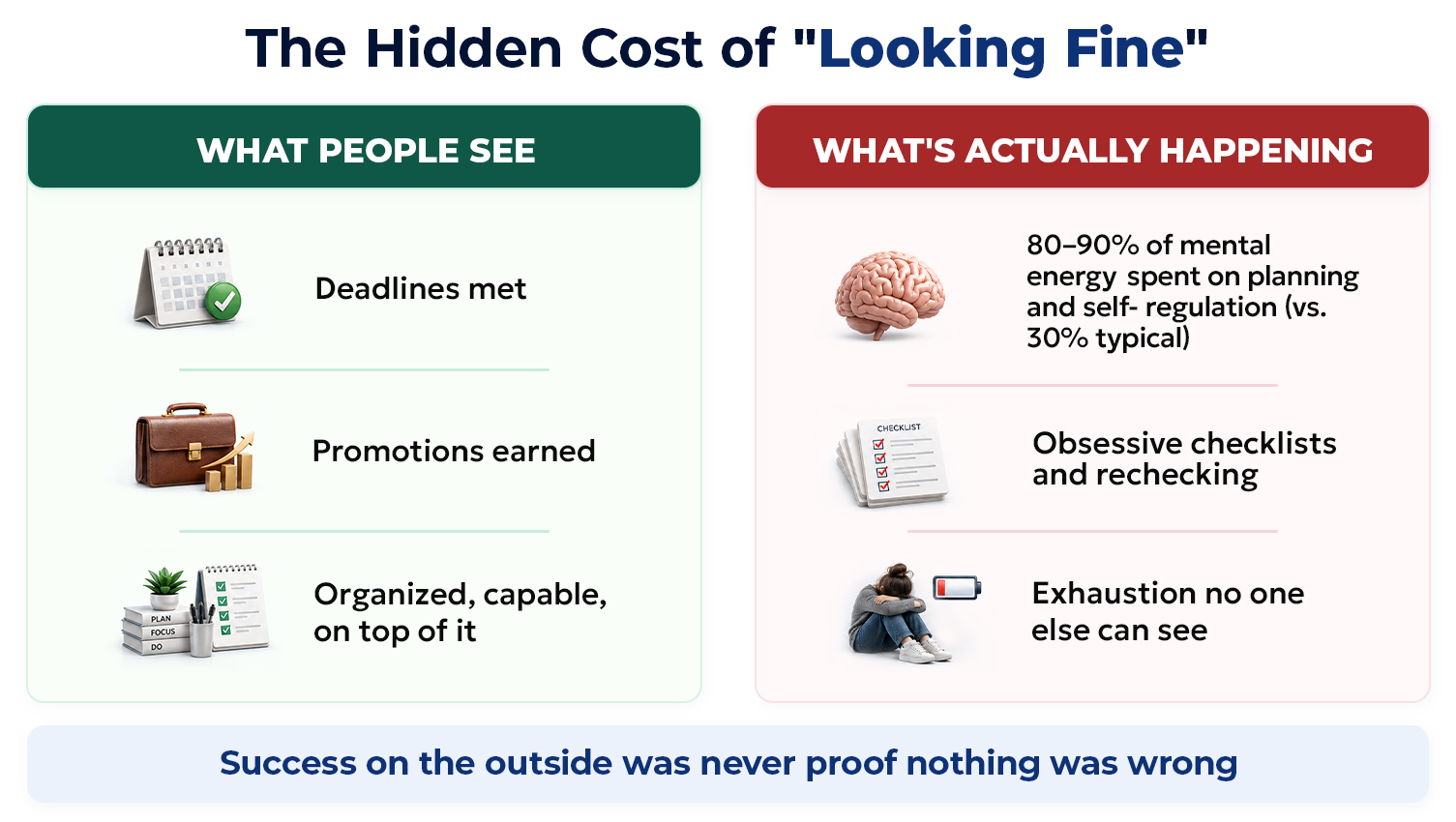
What the term actually describes is visible output, not internal ease. Someone can be meeting deadlines, earning promotions, and appearing entirely capable to colleagues and family, while privately managing a level of effort that would surprise almost everyone around them.
Being labeled high-functioning does not mean the ADHD is mild, and it does not mean less support is needed. It usually means one of three things is happening: real coping strategies have been built and are currently working, symptoms happen to be milder in some areas, or someone excels in specific domains while quietly struggling in others.
Why the Term Is Misleading
The phrase gets used a lot, but it deserves some pushback, because it can genuinely downplay what people are dealing with.
- It implies the condition itself is mild, when often the symptoms are just as significant as anyone else’s, only better hidden.
- It suggests success in one area, a career, for example, means the person isn’t struggling elsewhere, when impulsivity, disorganization, or emotional overwhelm may still be running underneath.
- It can make people around the person, and sometimes the person themselves, dismiss real struggles because “they seem fine.”
- Diagnostic criteria for ADHD were historically built around the male, hyperactive childhood presentation, which means the quieter, more internalized version now described as “high-functioning” has been missed in huge numbers of people, especially women, for decades.
Expert Insights
The current research evidence does not support a broad overdiagnosis narrative in adults. The field is generally understood to be catching up on decades of underdiagnosis, particularly in women and adults assigned female at birth.
Symptoms of High-Functioning ADHD
Attention and Focus
- Ability to hyperfocus intensely on tasks that are genuinely interesting, alongside real difficulty sustaining attention on anything routine or unstimulating
- Frequent daydreaming or mental drift during less engaging conversations or tasks
- Reliance on looming deadlines to actually start a task, rather than starting with time to spare
Internal and Emotional Symptoms
- Constant internal pressure to perform, even when external output looks fine
- Anxiety or a feeling of being overwhelmed that doesn’t match how well things appear to be going
- Rejection sensitivity, or a disproportionate emotional reaction to criticism or perceived failure
- Persistent self-doubt or a sense of “not good enough,” despite objective success
Compensatory and Behavioral Patterns
- Obsessive task lists, color-coded calendars, or backup systems layered on top of backup systems
- Compulsively rereading and rewriting emails or messages before sending them
- Arriving early or over-preparing to guard against the unpredictability ADHD can introduce
- Hyperfocus “catch-up” sessions, working late into the night, skipping meals or sleep to get something finished
Functional Symptoms
- Seemingly effortless success in one area of life alongside real, ongoing struggle in another
- Executive function difficulties, planning, prioritizing, and organizing, that get compensated for rather than resolved
- Time blindness, or a consistent difficulty accurately judging how long things will take
What Causes High-Functioning ADHD
The causes here are the same as ADHD generally. There is no separate biological pathway for a “high-functioning” version.
- Genetics. ADHD has a strong hereditary component. A family history significantly raises the likelihood of ADHD in general, regardless of how it eventually presents.
- Brain-based differences. Differences in how the brain regulates dopamine and executive function are well documented in ADHD and are present whether or not someone has developed effective coping strategies.
- What makes it look “high-functioning” isn’t a different cause. It’s a combination of factors, strong compensation strategies, high intelligence, specific environmental structure, or symptoms that happen to be milder, that together produce a version of ADHD that stays hidden longer.
How Masking and Compensation Work
Masking means consciously or unconsciously suppressing ADHD-related behavior to meet expectations at work, in relationships, or socially. It isn’t a single strategy that gets switched on. It’s an ongoing, effortful process that runs in the background of daily life.
Common compensatory patterns include:
- Perfectionism and over-preparation used to prevent mistakes before they happen
- Deadline adrenaline, where the pressure of a looming due date is what finally makes starting possible
- Elaborate organizational systems that can become more exhausting to maintain than the original task ever was
- Suppressing visible fidgeting, restlessness, or impulsive comments in professional or social settings
The cost of this is real and measurable. Sustained masking and compensation can be mentally exhausting. Constantly monitoring behavior, over-preparing, rechecking work, and suppressing visible symptoms may contribute to stress, fatigue, and burnout. The level of effort and its effects vary considerably from person to person. That gap doesn’t show up on a performance review. It shows up as exhaustion at the end of every single day.
Why It Often Goes Undiagnosed for Years
High-functioning ADHD frequently goes unrecognized well into adulthood, sometimes for decades, for a few consistent reasons:
- The coping mechanisms actually work, for a while, which removes the obvious signal that would normally prompt an evaluation.
- Diagnostic criteria were built around a childhood, hyperactive presentation, so quieter, internalized symptoms don’t match what most people, including some clinicians, expect ADHD to look like.
- Anxiety or depression often gets treated first, since those are what finally becomes visible, while the underlying executive-function pattern driving them goes unquestioned.
- Treatment for the anxiety or depression alone tends to produce partial improvement that then stalls, because it isn’t addressing the actual root cause.
What Finally Triggers a Diagnosis
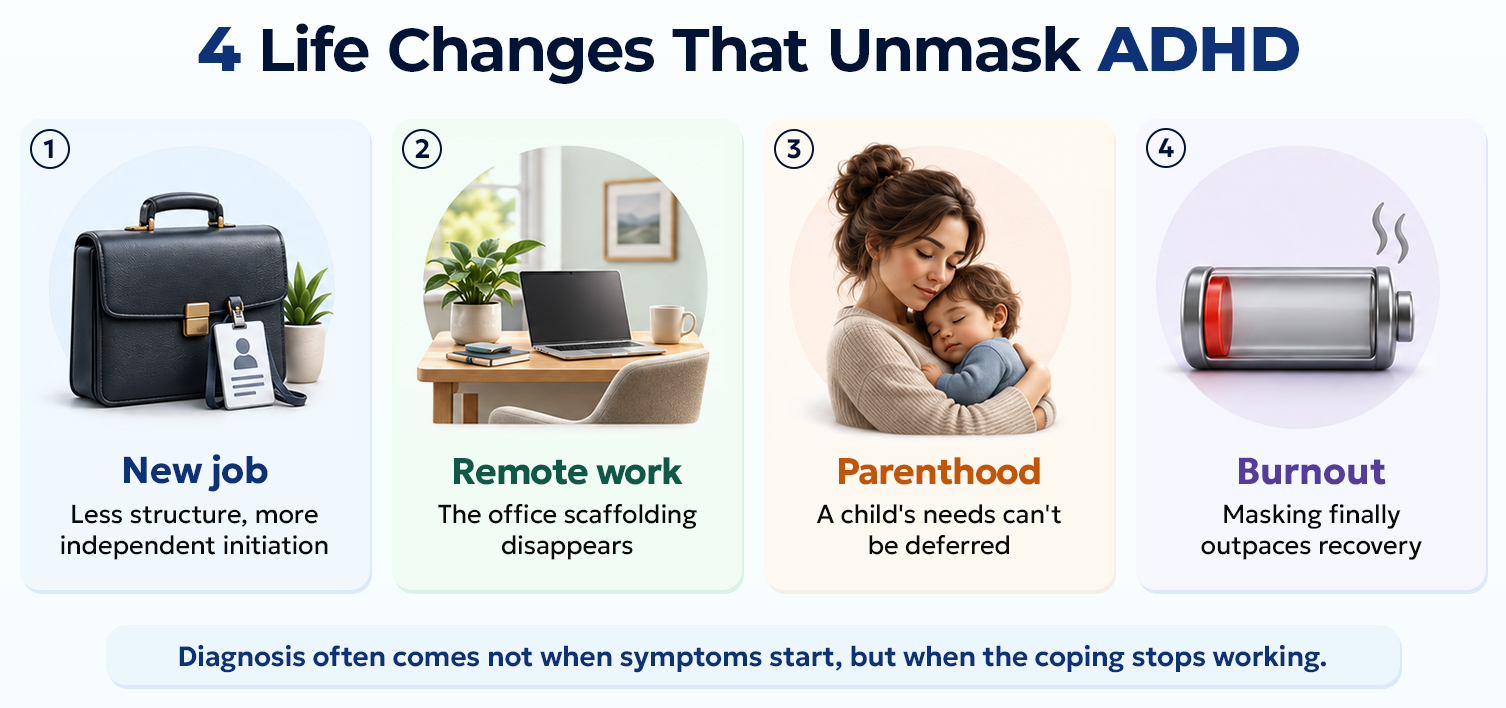
Diagnosis tends to arrive later in life, often in someone’s thirties, and it’s rarely random. It typically follows a shift that overwhelms the systems that used to hold everything together.
Common triggers include:
- A new job with less external structure or more independent initiation, remote work in particular tends to unmask ADHD that an office environment had been quietly scaffolding
- Graduate school or any open-ended, self-directed project with a distant deadline
- Parenthood, especially with a young child whose needs can’t be deferred the way a work task sometimes can
- Burnout, when the exhaustion of sustained masking finally outpaces what rest alone can repair
Concerned These Patterns Sound Familiar?
How It's Evaluated
There is no test that confirms high-functioning ADHD specifically, because it isn’t a separate diagnosis. Evaluation follows the same process as any adult ADHD assessment.
- A detailed clinical interview covering current symptoms and functional impact
- Confirmation that symptoms were present before age 12, even if no one connected the dots at the time
- Standardized adult rating scales, such as the ASRS, a well-validated screener developed with the World Health Organization
- Assessment of executive function specifically, since that’s often where the internal struggle is concentrated even when outward performance looks strong
- A conversation about co-occurring anxiety or depression, and whether those may actually be downstream of unaddressed ADHD rather than separate conditions
A screener alone cannot diagnose ADHD. It’s one part of a fuller clinical picture that a provider puts together over the course of an evaluation.
Treatment Options
Medication
Stimulant medications remain the most studied first-line option and can meaningfully reduce the internal effort required to maintain focus, cutting down on the exhausting compensation that’s been doing the work instead. Non-stimulant options are available for people who don’t tolerate stimulants well.
Therapy Targeting Pattern, Not Just Symptoms
Executive Function Coaching & Skills-based Support
Rather than adding more elaborate systems, effective treatment often means identifying which existing coping strategies genuinely help and which ones just mask symptoms at a real cost to wellbeing, then building on the former and reducing the latter.
Addressing masking directly. Part of treatment for many adults involves recognizing which behaviors are worth keeping (timers, reminders, structured routines) and which ones are quietly draining energy without adding real benefit (obsessive rechecking, never asking for help, perfectionism that has stopped serving a purpose).
High-Functioning ADHD vs. Typical ADHD Presentations
- Visibility: Classic childhood ADHD is often outwardly disruptive. High-functioning ADHD is internalized and largely invisible to people around the person.
- Impairment location: Rather than impairment showing up everywhere, it often concentrates in specific areas, home life, emotional regulation, or private time, while professional performance stays intact.
- Timing of recognition: Typical presentations are often caught in childhood. High-functioning presentations are frequently missed until adulthood, sometimes only after burnout.
- What’s underneath: Both share the same core symptoms of inattention, impulsivity, and executive dysfunction. The difference is the layer of compensation sitting on top.
When to Seek an Evaluation
Consider an evaluation if:
- You’ve been successful on paper but privately feel like you’re barely holding it together
- Maintaining your current pace requires noticeably more effort than it seems to for people around you
- Treatment for anxiety or depression has helped somewhat but hasn’t fully resolved how you feel
- A major life change, a new job, a child, graduate school, has started to unravel systems that used to work
- You relate strongly to needing deadlines, adrenaline, or last-minute pressure just to get started
When to Seek Urgent Support
High-functioning ADHD itself isn’t a medical emergency, but the burnout, anxiety, or depression that often accompanies it can become serious. If you’re experiencing thoughts of self-harm or feel unable to cope, call or text 988 to reach the Suicide and Crisis Lifeline, or call 911.
ADHD Care in New Jersey
For adults in New Jersey noticing this pattern, primary care is a reasonable place to start. A provider can review your history, current symptoms, and functional impact, then determine whether a full ADHD evaluation, treatment for co-occurring anxiety or depression, or both, makes sense as a next step.
Telehealth for ADHD Care
AZZ Medical Associates offers telehealth appointments in New Jersey for many ADHD-related visits, including initial screenings, follow-ups, and medication management check-ins. Some situations still call for an in-person visit, and your provider can help determine which format fits your specific situation.
ADHD Care at AZZ Medical Associates
AZZ Medical Associates provides ADHD evaluation and treatment for adults across New Jersey, including patients whose symptoms have been masked, compensated for, or misattributed to anxiety or stress for years.
- Primary Care
- Behavioral Health Services
- Medication Management
- Preventive Care
- Telehealth
Ready to Find Out What's Actually Going On?
If success has always felt harder to maintain than it should, an evaluation can bring real clarity, not just another coping strategy.
How to Prepare for an Appointment
- A written list of specific patterns, not just general impressions, since concrete examples are more useful than “I’ve always felt scattered”
- Notes on what strategies you currently rely on to stay functional (deadlines, checklists, hyperfocus, over-preparation)
- Any prior treatment history for anxiety or depression, and whether it fully resolved how you feel
- Family history of ADHD, even if undiagnosed in relatives
- Insurance information
Lifestyle & Supportive Approaches
- Retaining genuinely helpful tools, timers, external reminders, structured routines, while identifying which compensatory habits are draining more than they’re giving back
- Building in rest that isn’t just recovery from the last burnout cycle, but actual breathing room before the next one starts
- Reducing non-essential commitments during periods of high masking demand
- Practicing self-compassion around forgetfulness or inconsistency, rather than treating every lapse as a personal failure
Takeaway
High-functioning ADHD isn’t a milder version of ADHD. It’s the same condition, carrying the same underlying challenges, wrapped in a layer of compensation that’s been working hard enough, for long enough, that almost no one else can see it.
That invisibility is exactly what makes it worth taking seriously. Success on the outside was never proof that nothing was wrong. It was often the cost of managing something real, alone, for years.
Tired of Holding It Together Alone?
Success shouldn’t require this much effort behind the scenes.
FAQs About High-Functioning ADHD
Is high-functioning ADHD a real diagnosis?
No. It's an informal, descriptive term, not a clinical diagnosis. People described this way still meet the full diagnostic criteria for ADHD; they've simply developed effective coping strategies.
How is high-functioning ADHD different from regular ADHD?
The underlying condition is the same. The difference is how visible the impairment is. High-functioning ADHD tends to be internalized and masked through compensation, while symptoms may show up outwardly for others.
Can someone be very successful and still have ADHD?
Yes, and it's extremely common. Compensation strategies, high cognitive ability, and intense drive can produce significant professional or academic success while the person privately struggles to maintain it.
Why do so many adults get diagnosed later in life?
Coping mechanisms often work well enough for years, especially in structured environments. Diagnosis frequently follows a life change, a new job, parenthood, or burnout, that overwhelms those systems.
Is masking ADHD harmful?
It can be. Sustained masking requires significant mental effort and is linked to burnout, chronic exhaustion, and heightened anxiety. Some compensatory tools are genuinely helpful, but others cost more than they give back.
Can anxiety or depression be a sign of undiagnosed ADHD?
Sometimes. Treatment-resistant anxiety or depression in someone who is otherwise high-achieving is worth a second look for underlying ADHD, since treating the surface symptom alone often produces only partial improvement.
Does high-functioning ADHD need treatment if someone is already succeeding?
It depends. Being outwardly successful doesn't mean the internal struggle isn't real or that support isn't needed. Left unaddressed, the compensation required to maintain that success is often unsustainable long-term.