
Medically Reviewed by:
Samrah Waseem, MD
Read more
Publish On:
Last Updated on
- September 28, 2026

Inattentive ADHD, also called the predominantly inattentive presentation of ADHD, is characterized by persistent difficulties with attention, organization, working memory, and follow-through. A person may not appear outwardly hyperactive, but symptoms can still interfere with school, work, relationships, and daily responsibilities. Some people struggle to begin tasks, while others start easily but have difficulty sustaining attention and completing them on time.
For most of them, starting a task is an easy part, yet finishing it on time is the real challenge. This pattern typically begins in childhood and persists into adulthood, with some symptoms alleviated and others exacerbated.
What Is Inattentive ADHD?
Inattentive ADHD, formally known as attention-deficit/hyperactivity disorder, predominantly inattentive presentation, is a form of ADHD in which difficulties with attention, organization, memory, and task completion are more prominent than hyperactivity or impulsivity.
People with inattentive ADHD may appear quiet, calm, or capable while still struggling to stay focused, remember responsibilities, follow instructions, manage time, or complete tasks. Because obvious hyperactivity may be absent, inattentive ADHD can sometimes be overlooked.
ADHD begins in childhood, although symptoms may not be recognized until adolescence or adulthood. The way symptoms appear can also change as a person gets older and takes on different responsibilities.
Is Inattentive ADHD the Same as ADD?
ADD is an older term that was commonly used for attention difficulties without prominent hyperactivity. Today, healthcare professionals generally use the term ADHD, predominantly inattentive presentation, instead of ADD.
Someone who may previously have been described as having ADD may now be diagnosed with predominantly inattentive ADHD if they meet current diagnostic criteria.
Symptoms of Inattentive ADHD
Inattentive ADHD involves a persistent pattern of difficulty with attention and organization that interferes with everyday functioning. Symptoms may affect school, work, relationships, household responsibilities, and other areas of daily life.
The way symptoms appear can vary depending on a person’s age and circumstances. For example, a child may repeatedly lose school materials, while an adult may struggle with appointments, deadlines, bills, or multi-step projects.
9 Common Signs of Inattentive ADHD
Common signs may include:
- Frequently overlooking details or making avoidable mistakes
- Difficulty maintaining attention during tasks or conversations
- Appearing not to listen when spoken to directly
- Difficulty following instructions or completing tasks
- Problems organizing tasks and responsibilities
- Avoiding or delaying tasks that require sustained mental effort
- Frequently losing items needed for everyday activities
- Becoming easily distracted
- Forgetting everyday responsibilities or activities
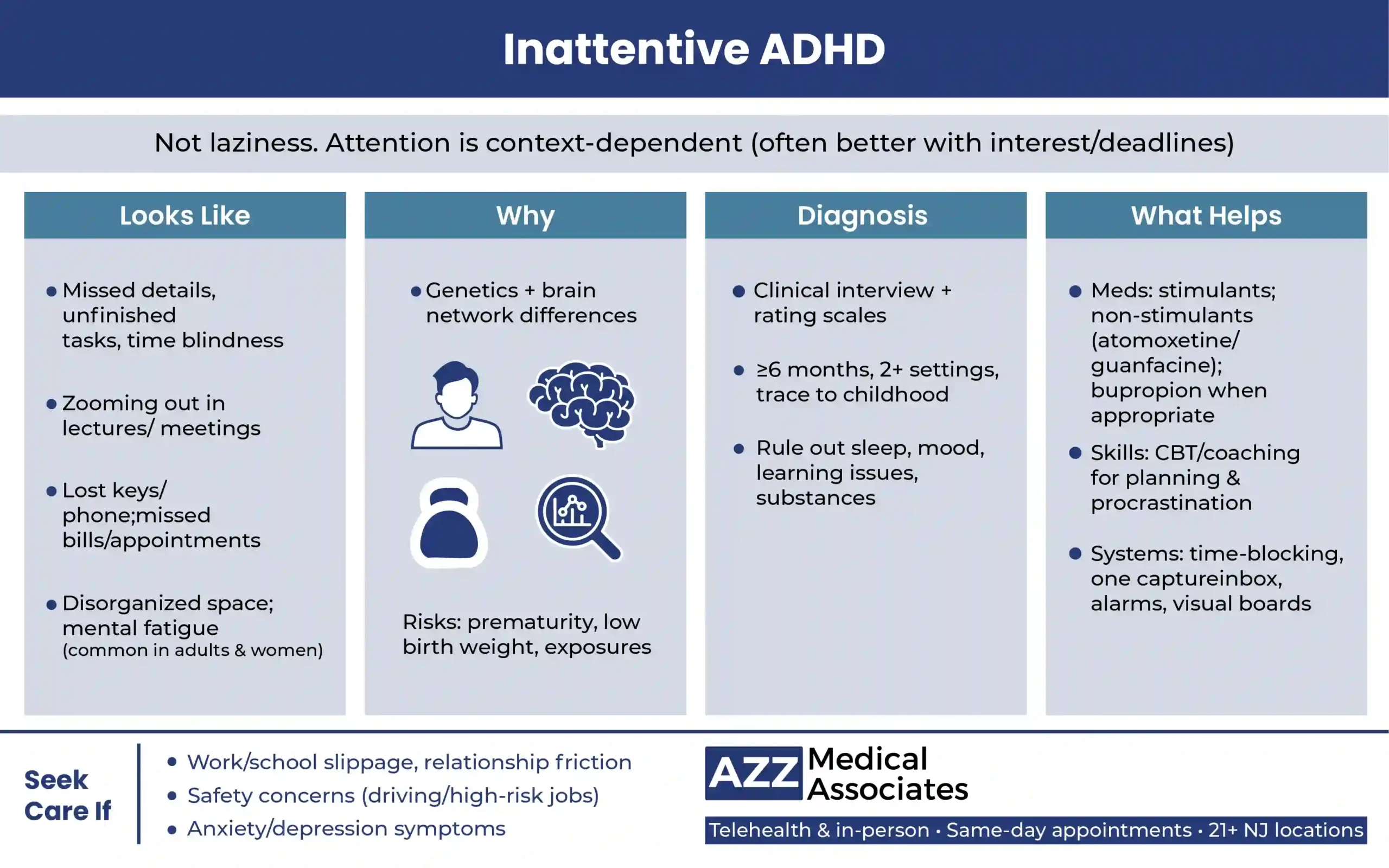
What Inattentive ADHD Can Look Like in Daily Life
Attention & accuracy
- Missed details and small errors
- Focus fades on long reading, meetings, tasks, or lectures
- Listening lapses; needs repetition
Follow-through & time
- Starts tasks, loses focus mid-stream; incomplete steps
- Time blindness, missed deadlines, and lateness
- Avoids high-cognitive-load tasks (forms, multi-step processes)
Organization & working memory
- Disorganized spaces/systems; “where do I start?”
- Misplaces keys, wallet, phone, documents
- Forgets routine chores, bills, callbacks
Presence & recall
- Easily pulled off task by internal/external distractions
- Short-term memory slips, rereads, loses train of thought
- Impatience, low frustration tolerance, decision fatigue
- Relationship strain from lateness or missed cues
- Performance hits (rework, late fees, safety risks in instruction-heavy roles)
- Self-image costs from being mislabeled “lazy/careless”
- More quiet overwhelm than hyperactivity; masking, perfectionism, fatigue
- Symptom flares around hormonal shifts (PMDD, postpartum, perimenopause)
Inattentive ADHD Symptoms by Age
Inattentive ADHD Symptoms in Children
Children with inattentive ADHD may not display the disruptive behavior commonly associated with ADHD. Instead, they may appear dreamy, forgetful, disorganized, or easily distracted.
Common examples may include:
- Frequently losing homework, pencils, books, or school materials
- Forgetting instructions shortly after hearing them
- Difficulty completing classwork or homework
- Daydreaming during lessons or conversations
- Missing details in assignments
- Difficulty organizing schoolwork
- Needing frequent reminders to complete routines
Occasional forgetfulness is normal in children. ADHD becomes more concerning when symptoms are persistent and interfere with everyday functioning.
Inattentive ADHD Symptoms in Teens
As school, social, and personal responsibilities increase, inattentive ADHD may become more noticeable during adolescence.
Teens may struggle with long-term assignments, studying, deadlines, planning, remembering responsibilities, managing schedules, or completing several tasks at once.
Inattentive ADHD Symptoms in Adults
In adults, inattentive ADHD may affect work, relationships, finances, household responsibilities, and everyday organization.
Common difficulties can include missing deadlines, forgetting appointments, losing important items, procrastinating on complex tasks, struggling to prioritize responsibilities, or becoming distracted during meetings and conversations.
Inattentive ADHD in Girls and Women
Inattentive symptoms may sometimes be less obvious in girls and women because they may occur without prominent hyperactivity. Difficulties with organization, attention, memory, time management, and task completion may become more noticeable as responsibilities increase.
Causes of Inattentive ADHD
Multifactorial, neurodevelopmental, no single cause
- Strong familial clustering; multiple genes tied to dopamine/norepinephrine and executive-function networks
- Frontostriatal and frontoparietal circuit variation (sustained attention, planning, working memory)
- Default-mode network dysregulation contributing to mind-wandering
- Prematurity and low birth weight
- Prenatal exposure to nicotine/alcohol; environmental toxins (e.g., lead)
- Early adversity/stress can interact with genetic risk
What does not cause ADHD?
- Not caused by bad parenting, low willpower, or less effort
- “Hyperfocus” under interest/deadlines doesn’t rule ADHD out
- Inconsistent/Context-dependent attention doesn’t rule out ADHD
- Underachievement despite ability and chronic disorganization
- Social friction; safety issues where precise instruction-following matters
- Secondary anxiety, low mood, and self-criticism
Inattentive vs. Hyperactive vs. Combined ADHD
ADHD can appear in three main presentations. The primary difference is which groups of symptoms are most prominent.
| ADHD Presentation | Main Pattern | Common Examples |
|---|---|---|
| Predominantly inattentive | Attention and organization difficulties are more prominent | Forgetfulness, losing items, distractibility, incomplete tasks |
| Predominantly hyperactive-impulsive | Hyperactivity and impulsivity are more prominent | Fidgeting, interrupting, difficulty waiting, excessive activity |
| Combined presentation | Significant symptoms from both groups | Inattention together with hyperactivity or impulsivity |
A person’s ADHD presentation can change over time as symptoms and circumstances change.
Functional impact of Inattentive ADHD (measurable)
- Missed or rushed deadlines; late fees and penalty notices
- “Messy” or over-cluttered workspaces that hide important items
- Strained teamwork, perceived as unreliable despite strong ideas
- Safety risks in high-detail or instruction-heavy roles
- Self-criticism and low mood from repeated near-misses
If this sounds familiar and has been persistent since childhood, even if you compensated in school, you need professional assistance. Know that professional psychiatrists and psychologists of AZZ Medical Associates are always here for you (in person and via telehealth).
How Is Inattentive ADHD Diagnosed?
There is no single blood test, brain scan, or online questionnaire that can independently diagnose inattentive ADHD. Diagnosis involves a clinical evaluation that considers symptoms, developmental history, daily functioning, and other possible explanations for attention difficulties.
What an ADHD Evaluation May Include
Clinical interview: A healthcare professional may discuss current symptoms, childhood history, school or work functioning, relationships, and everyday responsibilities.
Symptom rating scales: Standardized questionnaires may be used to help document the frequency and impact of ADHD symptoms.
Information from different settings: When appropriate, information from parents, teachers, partners, or others may help show whether difficulties occur in more than one environment.
Assessment of functional impact: The evaluation considers how symptoms affect school, employment, relationships, household responsibilities, and other areas of daily life.
Evaluation for other conditions: Anxiety, depression, sleep problems, learning difficulties, effects of medications, and other medical or mental health conditions can sometimes cause or worsen attention difficulties.
Symptoms of Inattentive ADHD
Focused on what you love, overwhelmed by the rest?
Treatment Options for Inattentive ADHD
Treatment for inattentive ADHD is individualized based on a person’s age, symptoms, medical history, daily challenges, preferences, and any coexisting conditions.
Depending on the individual, treatment may include medication, behavioral strategies, psychotherapy, organizational support, and accommodations or changes at school, work, or home.
1) Medications for ADHD
Stimulants:
- Methylphenidate or amphetamine formulations are the most studied stimulants for inattentive ADHD. They boost dopamine/norepinephrine signaling, improving initiation, persistence, and working memory.
- Long-acting options reduce peaks/valleys; timing can be aligned to your day (e.g., deep-work hours).
- Side effects may include reduced appetite, mild insomnia, or increased heart rate. We mitigate with dose timing, nutrition, and monitoring.
- Atomoxetine (a non-stimulant): helpful for inattentive ADHD medication needs with 24-hour coverage; takes a few weeks to reach full effect.
- Guanfacine/clonidine ER: steadies distractibility and emotional reactivity; can aid sleep.
- Bupropion (off-label): useful when inattention pairs with low mood; avoid seizure-risk or active eating disorders.
There’s no single best medication for inattentive ADHD in adults; the “best/suitable” is the one that measurably improves your symptoms with manageable side effects.
2) Behavior Modifications (customized, not generic)
- CBT for ADHD: externalize time (visible timers), break projects into next visible steps, set friction-free routines (auto-pay, auto-refills).
- Coaching: weekly planning sprints, calendar hygiene, batch email windows, and “single-screen work” rules.
- Environment design: quiet spaces, noise-blocking, scheduled deep-work blocks, clear written instructions.
For inattentive ADHD in women: targeted support for perfectionism, masking, and burnout patterns common in late-diagnosed adults.
3) Lifestyle Levers that Actually Help
- Sleep regularity (same sleep/wake window, wind-down routine).
- Exercise snacks (5–10 minutes of brisk movement) to boost executive function.
- Protein-forward breakfasts to stabilize attention.
- Digital hygiene: notification triage, do-not-disturb during focus blocks.
How We Track Progress (so changes stick)
- Weekly snapshot: focus (0–10), task completion rate, sleep window, and side effects.
- Adjustments: dose timing, formulation, or meds for inattentive ADHD only when the data say so.
- Outcome targets: on-time deliverables, fewer late fees, cleaner inbox, and fewer “re-work” hours.
Safety First: When to Contact Your Clinician
- New or worsening suicidal thoughts
- Chest pain, fainting, or irregular heartbeat
- Severe rash, facial swelling, or trouble breathing
- Fever with muscle rigidity/confusion
- Yellowing eyes/skin or dark urine
We’ll coordinate same-day guidance via telehealth or bring you into one of our 21+ New Jersey offices when needed.
Living With Inattentive ADHD
Inattentive ADHD can affect everyday routines, but appropriate treatment and practical systems may make symptoms easier to manage.
Helpful strategies may include:
- Breaking larger tasks into smaller steps
- Using calendars, reminders, or written checklists
- Keeping important items in consistent locations
- Creating predictable routines
- Reducing unnecessary notifications and distractions
- Requesting written instructions when helpful
- Discussing appropriate accommodations at school or work
The most useful strategies vary between individuals, so it may take time to identify which approaches work best.
When Should You Consider an ADHD Evaluation?
Consider speaking with a healthcare professional if difficulties with attention, organization, forgetfulness, or task completion:
- Have been present for a long time
- Occur in more than one area of life
- Interfere with school, work, relationships, or everyday responsibilities
- Continue despite attempts to improve organization or routines
- Could potentially be related to ADHD or another health condition
A professional evaluation can help determine whether ADHD or another condition may be contributing to the symptoms.
Looking for an ADHD evaluation?
AZZ Medical Associates provides ADHD evaluation and treatment options for eligible patients through in-person and telehealth care.
FAQs
Is inattentive ADHD real if I did well in school?
Yes. Many bright people compensate until demands outgrow workarounds, often in college or career transitions.
What’s the difference between inattentive and hyperactive ADHD?
Inattentive = distractibility and disorganization; hyperactive = motor restlessness and impulsivity. Many have some of both.
What causes inattentive ADHD?
The exact cause of inattentive ADHD is not fully understood. Research suggests that genetics plays a major role, alongside differences in brain development and activity. Certain prenatal, early-life and environmental factors may also influence risk. Inattentive ADHD is not caused by poor parenting, laziness or a lack of discipline.
What is inattentive ADHD in women?
Inattentive ADHD in women may appear as persistent forgetfulness, disorganization, difficulty focusing, procrastination, poor time management and feeling mentally overwhelmed. Because these symptoms are often less visibly disruptive than hyperactivity, girls and women may go undiagnosed until adulthood. Some manage well earlier in life but experience greater difficulty as work, family and daily responsibilities increase.
How is inattentive ADHD diagnosed?
There is no single test for inattentive ADHD. Diagnosis typically involves a detailed clinical interview, medical and mental-health history, symptom rating scales and an evaluation of how symptoms affect daily functioning in more than one setting. The clinician also looks for evidence that symptoms began before age 12 and rules out conditions such as anxiety, depression, sleep disorders or learning difficulties.
What’s the ICD-10 code for ADHD inattentive type?
F90.0 — ADHD, predominantly inattentive type.ICD-11 (where applicable): 6A05.0 — ADHD, predominantly inattentive presentation.
How is inattentive ADHD treated?
Inattentive ADHD is commonly treated with an individualized combination of medication, behavioral therapy, cognitive behavioral therapy, organizational strategies and practical support at school or work. Treatment depends on the person’s age, symptoms, health history and daily challenges. Regular follow-up helps the clinician assess progress, manage side effects and adjust the treatment plan when necessary.
Which ADHD medication is best for inattentive type?
There is no single ADHD medication that works best for everyone with the inattentive type. Clinicians may consider stimulant or non-stimulant medications based on the patient’s age, medical history, symptoms, other conditions, possible side effects and response to previous treatments. ADHD medication should only be started, changed or stopped under the supervision of a qualified healthcare professional.
Do I need medication forever?
Not always. We reassess regularly. Some stay on long-term; others taper once skills and structures are solid.
Can I get virtual inattentive ADHD care in New Jersey?
Yes. AZZ Medical Associates offers telehealth appointments for eligible patients located in New Jersey, including ADHD evaluations and follow-up care when clinically appropriate. In-person appointments are also available at AZZ Medical locations across the state.