

Health anxiety, also called illness anxiety disorder, is a persistent fear of serious disease and is far more severe than everyday, minor thoughts and sensations about health consciousness. In this disorder, the worry itself drives distress and manifests itself in routines like checking, doctor-hopping, or avoiding care.
It can be care-seeking (through self-exams, repeated appointments, or online searches) or care-avoidant (skipping care due to fear of bad news). The severity of symptoms often rises during stress and may increase with age. AZZ Medical Associates provides coordinated mental health services for people whose health worries interfere with daily life.
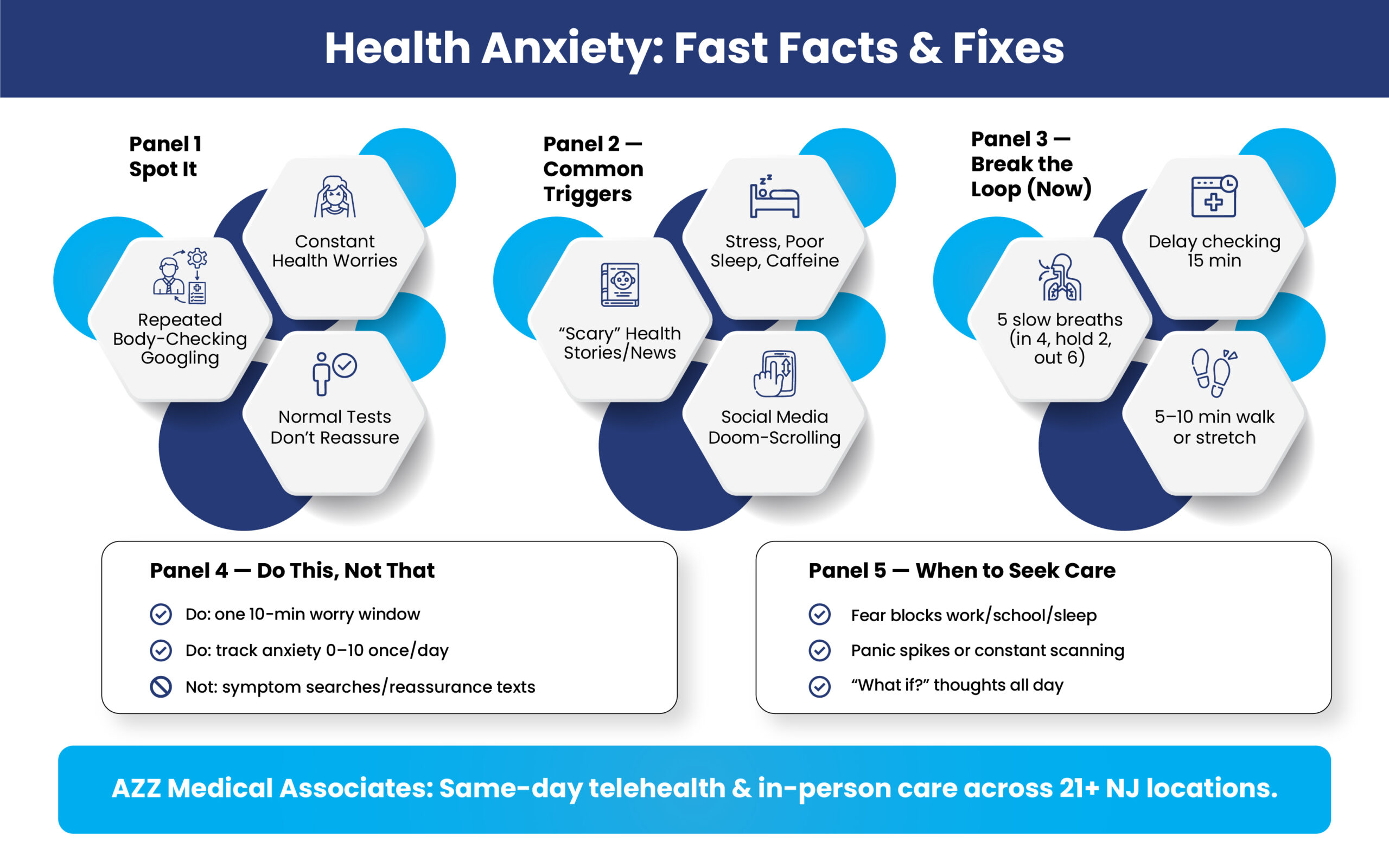
Managing Health Anxiety: What Helps and What to Avoid
| Triggers and Symptoms | What Helps | What to Avoid | When to Seek Care |
|---|---|---|---|
| Constant body-checking, symptom Googling, or fearing that ordinary sensations signal a serious illness. | One coordinating clinician, CBT skills, structured check-ins, and uncertainty-tolerance practice. | Compulsive Googling, repeated reassurance-seeking, unnecessary repeat testing, and doctor-shopping. | New or changing symptoms, objective warning signs, or any thoughts of self-harm. |
What it is, and What it isn’t
- Focus centers on the meaning of sensations (e.g., “headache = tumor”), not just the discomfort of health anxiety.
- Reassurance of abandoning these habits rarely lasts; online searching and self-checks return quickly.
- Differs from somatic symptom disorder (distress about symptoms’ impact) and from General Anxiety Disorder (worry across many life areas). Overlap with OCD health anxiety is common when compulsions (checking, Googling, repeated tests) are present.
Health Anxiety Action Table of AZZ
Health Anxiety Symptoms
Expert Insights
- A gentle way forward with health anxiety is to build one steady care plan with a single clinician.
- Then practice CBT skills that shrink compulsions like body-checking and late-night Googling.
- When a new sensation pops up, label it, breathe, and give it a day or two before seeking reassurance, most spikes fade when you don’t chase them.
- Keep a short “if/then” card (if worry rises → use grounding, delay checking, return to planned activities) so you act from a plan, not from panic.
Thinking & Behavior
- Preoccupation with having or getting a serious illness; feared illness can change over months.
- Minimal or normal sensations misread as dangerous: palpitations, dizziness, tingling, GI upset, jaw clenching, muscle twitches, fatigue.
- Repeated body checks (moles, lymph nodes, pulse, temperature, blood pressure).
- Reassurance cycles: appointments, tests, urgent care visits, or repeated “Am I okay?” questions to others.
- Excessive health-related internet use, or avoidance of medical shows, clinics, and hospitals.
- Acting “as if ill” (skipping exercise, social events) or continually talking about symptoms.
- Episodes can trigger anxiety attack surges that mimic medical emergencies
Impact of Health Anxiety
- Work, school, and relationships suffer; finances are strained by repeated care.
- Anxiety itself produces physical symptoms, such as headaches, chest pressure, and stomach upset, that fuel more fear.
Stuck in the Google search loop?
Reasons, Causes & Risk Factors of Health Anxiety
Beliefs & Learning
- Intolerance of uncertainty about the body; belief that any odd sensation signals grave disease.
- Modeling from caregivers who worried excessively about health.
- Prior illness or family history makes normal sensations feel threatening.
Life Context
- Major stress; exposure to rare-illness stories; repeated reminders of death/illness at work or online.
- Trauma history, childhood illness, or abuse.
- Personality styles that gravitate to worry; heavy “symptom-search” internet use.
Co-occurring Conditions
- Depression, other anxiety disorders, OCD, or health-focused compulsions.
- Health anxiety may coexist with Social Anxiety Disorder or Separation Anxiety, but illness fear remains the central theme.
Expert Insights
- When fear hits, switch to a “brief check, then back to life” rule: one quick scan (60 seconds max), no mirrors or apps, then return to your task with a timer set for 15 minutes.
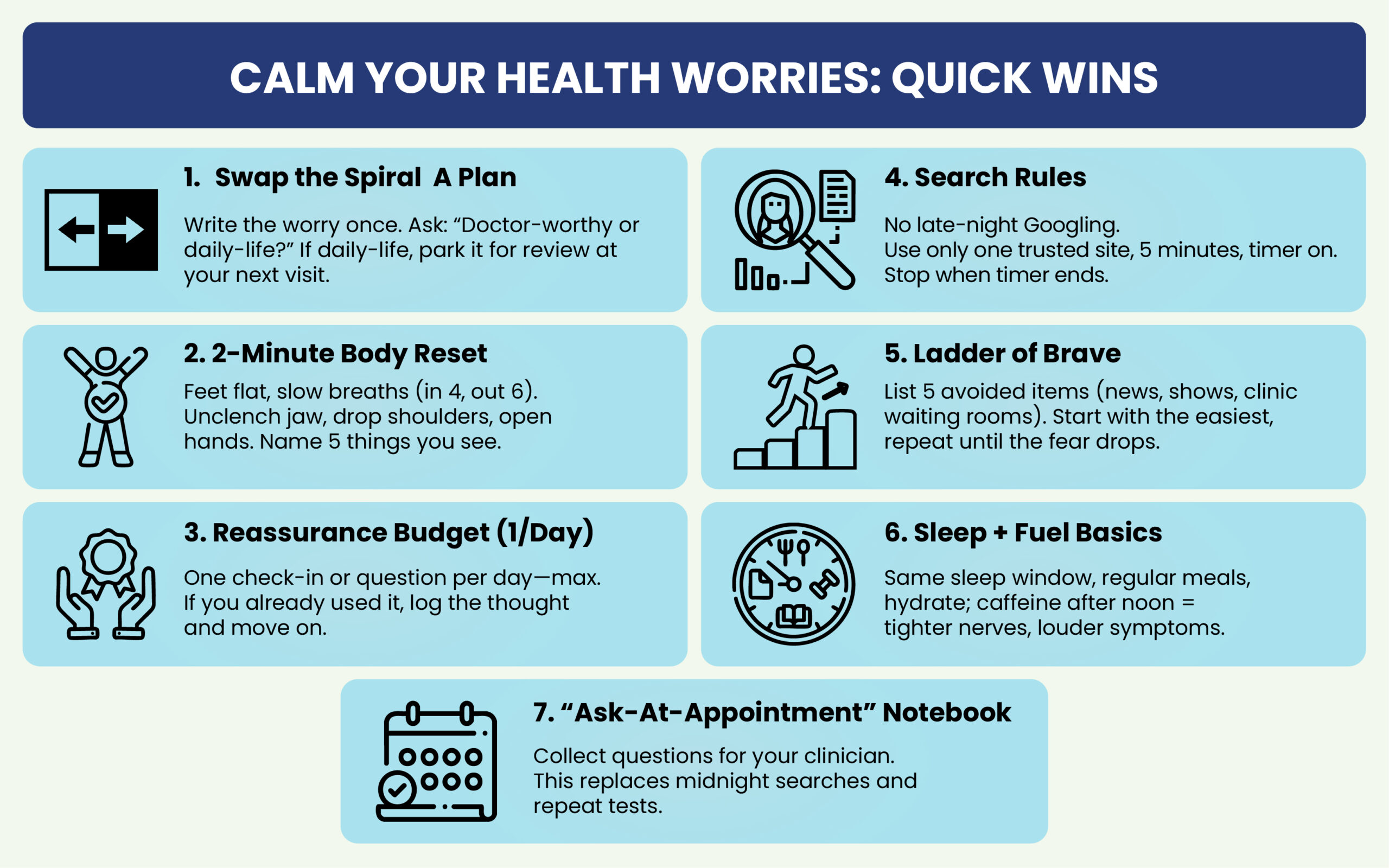
- Park worries in a notebook labeled “to ask at my next appointment,” so questions go to your clinician, not to search engines.
- Build a daily floor of steadies (sleep window, meals, light exercise); a calmer body makes fewer false alarms.
Duration and Complications of Health Anxiety
- It is a long-term condition with ups and downs; it may worsen with age or stress.
- Relationship conflict, missed work, disability claims, and unnecessary tests (and their associated risks) can follow.
- Untreated, the risk of major depression increases.
Diagnosis of Health Anxiety and DSM-5
Board-certified clinicians of AZZ Medical Associates first exclude urgent medical problems with focused exams and sensible tests, then assess for:
- Persistent illness preoccupation ≥6 months (illness target may change).
- High health-related anxiety with repeated checking or medical avoidance.
- Distress or impairment in daily life.
- Not better explained by another disorder (e.g., somatic symptom disorder, primary mood disorder). Search phrases like “health anxiety DSM-5” reflect this modern classification; “hypochondriasis” is no longer used as a primary diagnosis.
You need clarity, not more tests
Evidence-based treatment of AZZ Medical Associates
Cognitive Behavioral Therapy (CBT) for health anxiety
- Reframe interpretations: learn to view body sensations accurately rather than catastrophically.
- Exposure with response prevention (ERP): face triggers (e.g., sitting with palpitations, watching a medical segment) without checking, Googling, or seeking reassurance.
- Cut reassurance loops: reduce self-exams, repeat visits, and “doctor-shopping”; set one coordinating clinician.
- Uncertainty tolerance: skills for riding out urges and delaying checks.
- Relapse plan: written steps for flares, including limits on tests and clear follow-up intervals.
If searching for help, terms like “cognitive behavioral therapy for health anxiety,” “CBT for health anxiety,” and “health anxiety therapist” are appropriate. Evidence and data tell us that many choose psychological services via telehealth.
Medications for Health Anxiety
- SSRIs (sertraline, fluoxetine, escitalopram; sometimes SNRIs like venlafaxine) reduce persistent anxiety and co-occurring depression.
- Dosing is individualized with regular follow-up in early weeks to review benefits and side effects.
- Medicines complement not replace CBT.
Structured Self-care
- Diary of checking, searches, and reassurance-seeking; aim to reduce weekly.
- Balanced-thought table: worry in column A (“numb fingers = stroke”); grounded alternative in column B (“likely posture or tension”).
- Delay & replace: postpone checks 30–60 minutes; do a walk, call, chore, or planned activity.
- Gradual return to avoided tasks (exercise, travel, social plans).
- Relaxation and activity: progressive muscle relaxation, paced breathing, mindfulness, regular aerobic movement, and consistent sleep.
- Limit substances that worsen arousal (alcohol, recreational drugs).
- Internet rules: limited, scheduled viewing of reputable sources only—or bring questions to your planned visit instead.
Support for Family and Partners
- Reassure feelings, not symptoms: repeated “checks” prolong the cycle.
- Stick with one clinician, structured treatment for health anxiety, and a shared plan to resist on-demand tests.
- Encourage and praise “no-checking” wins and stepwise exposures.
Care with AZZ Medical Associates: In-person & Telehealth
- Same-day access to health anxiety therapy, coordinated treatment of health anxiety, and medication management when needed.
- Walk-in and weekend appointments are offered on availability
- All insurances are accepted
- Set reasonable test limits, consolidate care with one clinician, and build exposure plans tailored to your triggers.
- Evening options: multiple local sites. If you’re searching “health anxiety therapist near me,” scheduling is streamlined.
Tired of constant checking & reassurances?
FAQs
What causes health anxiety?
A mix of beliefs about illness, learning history, stress, trauma, and high intolerance of uncertainty, often reinforced by frequent online searching.
What are typical health anxiety symptoms?
Common symptoms include persistent worry about illness, anxiety-related sensations such as headaches, stomach upset, palpitations, or tingling, repeated checking or avoidance, and limited reassurance after normal test results.
Is there a cure for health anxiety?
Most people improve markedly with health anxiety therapy—CBT/ERP—and, when indicated, medication. The goal is normal life with manageable uncertainty.
How is this different from panic or Social Anxiety Disorder?
Panic focuses on sudden surges; social anxiety centers on scrutiny and embarrassment. Health anxiety centers on disease fear despite normal exams.
Is health anxiety the same as hypochondria?
Hypochondria is an older term commonly associated with health anxiety. Clinicians now use diagnoses such as illness anxiety disorder or somatic symptom disorder, depending on whether significant physical symptoms are present.
What is severe health anxiety?
Health anxiety may be severe when illness-related fears are persistent, cause repeated checking, testing, reassurance-seeking, or medical visits, and significantly disrupt sleep, work, relationships, or daily activities.
How do I overcome health anxiety?
Cognitive behavioral therapy can help people interpret physical sensations more accurately, reduce repeated checking and reassurance-seeking, and become more comfortable with uncertainty. Treatment should be personalized by a qualified clinician.
Can health anxiety cause real physical symptoms?
Yes. Anxiety can cause genuine physical sensations, including headaches, a racing heart, chest pressure, muscle tension, dizziness, and stomach upset. New, severe, or worsening symptoms should still be medically evaluated.
How long does health anxiety last?
The duration varies. Symptoms may be long-term or fluctuate during periods of stress. Appropriate therapy, consistent medical care, and medication when clinically indicated can help reduce their frequency and impact.